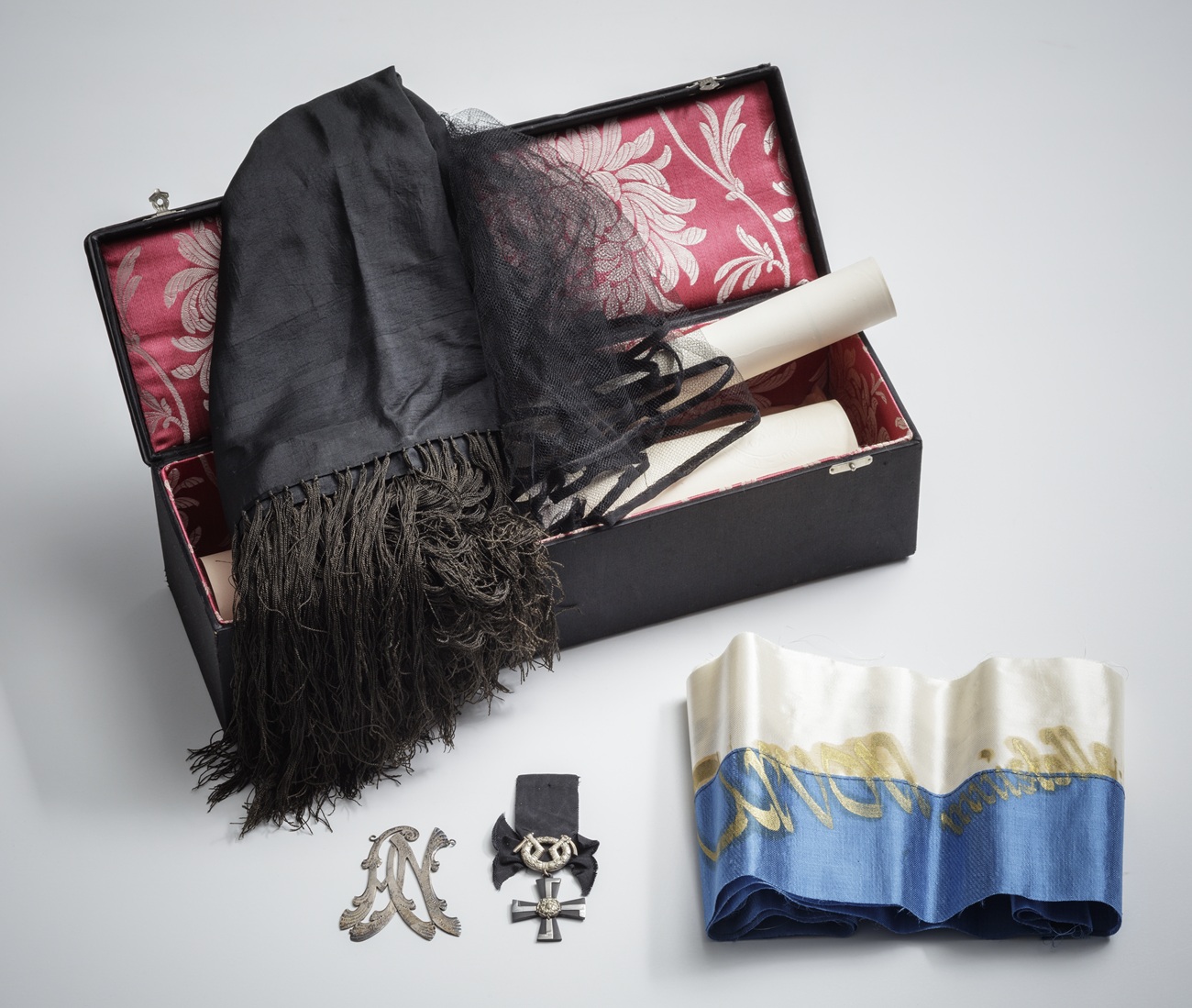
Lempi stored items relating to her husband Arvo’s disappearance at the front, his being declared killed in action and his funeral in a box covered with black cloth. Decades later, the group of items was added to the National Museum of Finland’s collections under the name ‘mourning box’.
The box contains a letter from Arvo’s platoon leader dated 29 July 1941. In it, he tells Lempi about Arvo’s disappearance in a battle fought near Konnunkylä in Nuijamaa on 11–12 July. The letter conveys uncertainty, but also hope, as Arvo has not been found.
Later that autumn, a letter dated 16 October 1941 and addressed to Lempi states that no news has been received of her husband. The letter concludes by expressing sympathy for her profound grief. The personal expressions of mourning of a widow who lost her spouse include a black mourning veil and headscarf, folded away in the box for safekeeping.
During the war, personal loss was incorporated into the national narrative of collective sacrifice and heroism. In the mourning box, this is reflected in a printed letter of condolence on Arvo’s death in action bearing the signature of C. G. E. Mannerheim, Commander-in-Chief of the Finnish Defence Forces, as well as a Cross of Liberty mourning cross sent to Lempi in January 1946 and its certificate of award.
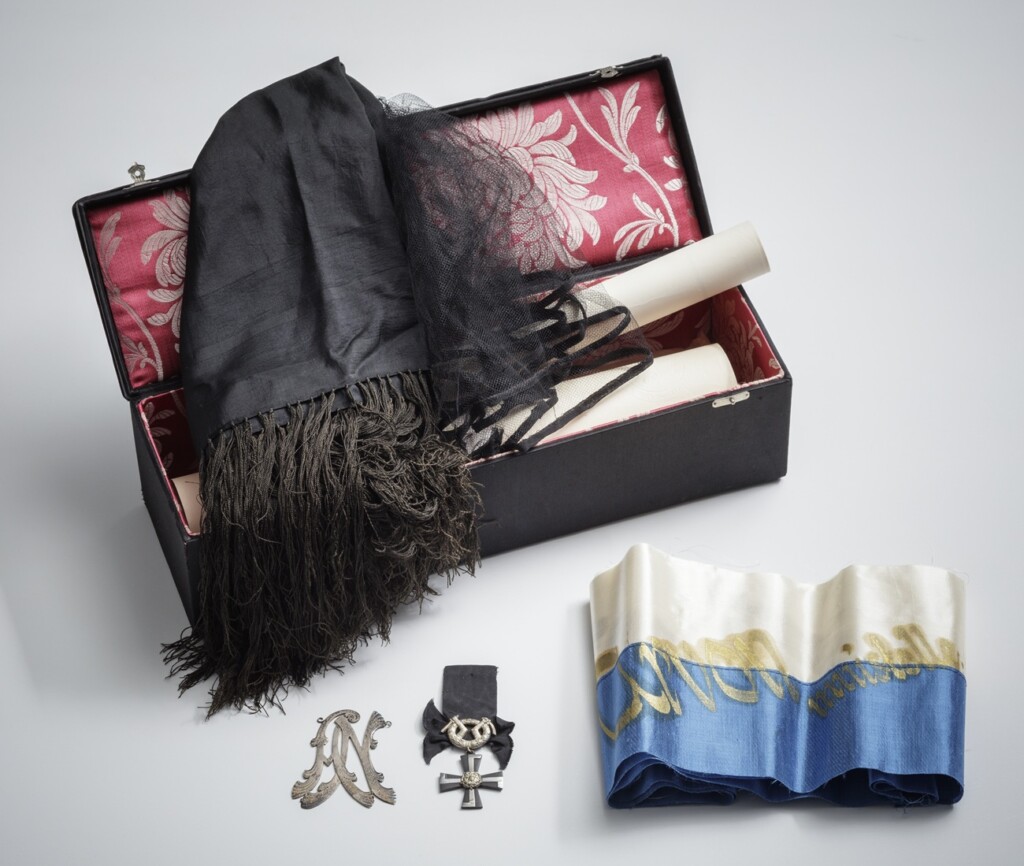
The mourning box and its contents. Photo: Ilari Järvinen, Finnish Heritage Agency.
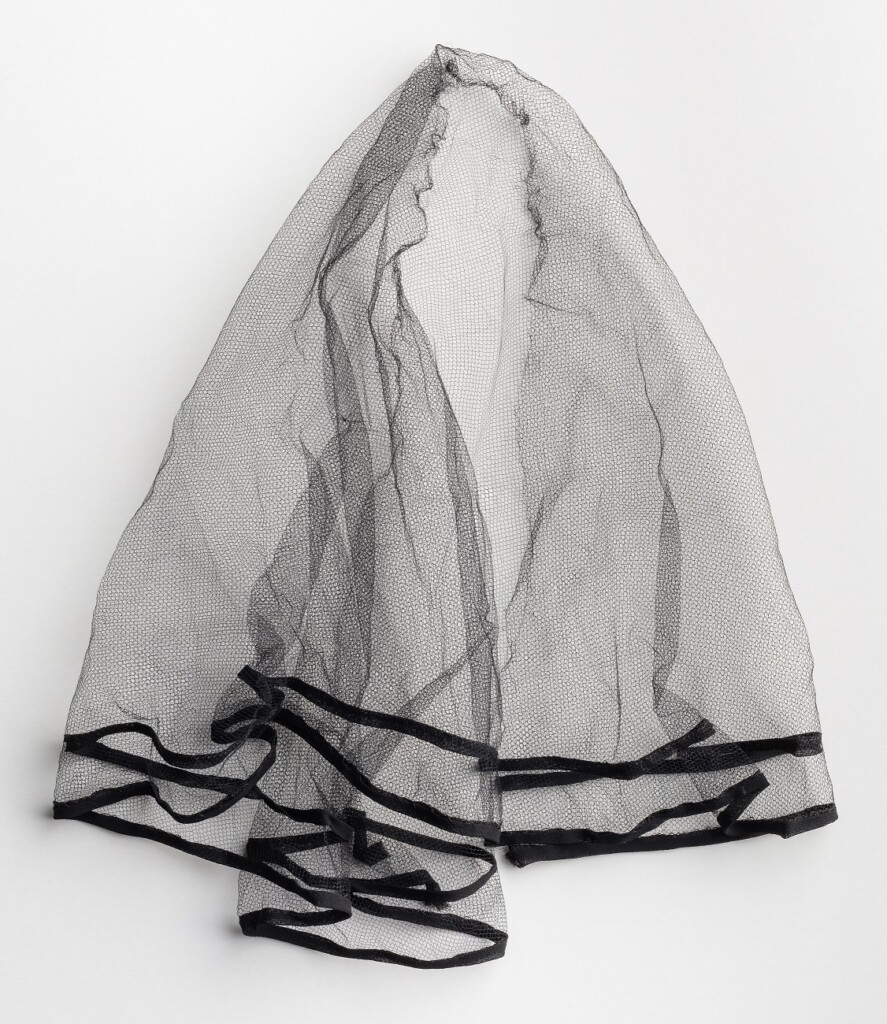
The black veil was gathered and attached to a headdress. Photo: Ilari Järvinen, Finnish Heritage Agency.
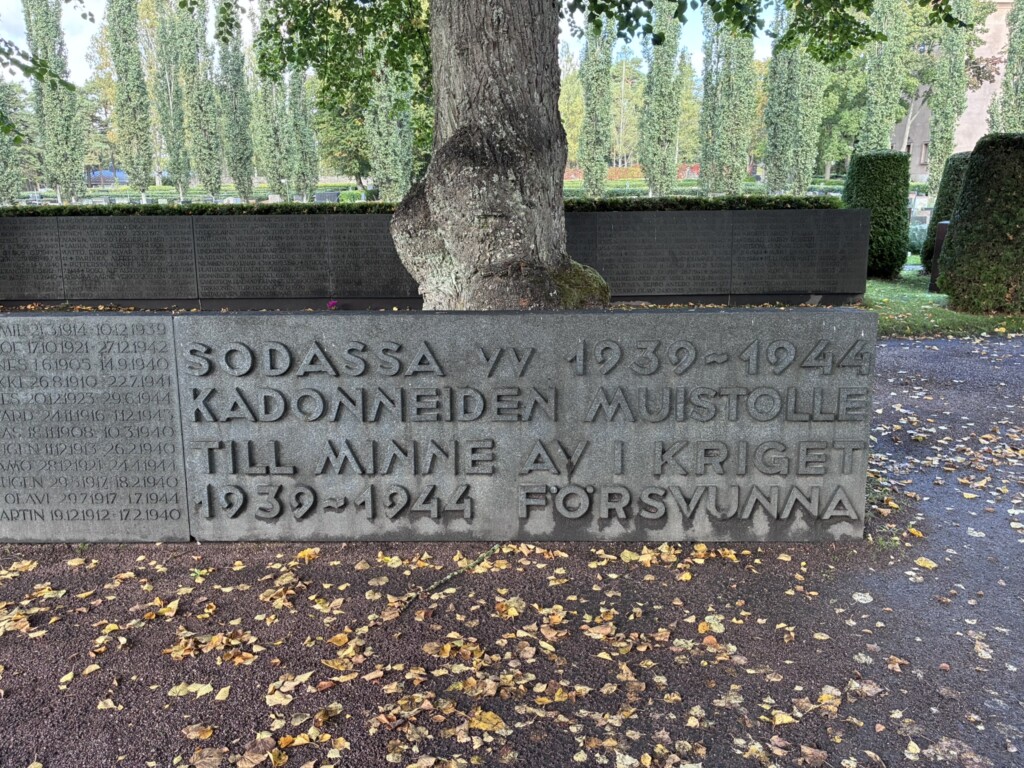
A ribbon from the funeral wreath and a monogram bearing the deceased’s initials, A. N., have been preserved from Arvo’s memorial service. Arvo’s name can be found on the Wall of the Missing at the Hietaniemi Heroes’ Cemetery. The Wall of the Missing was unveiled in 1954. The memorial was designed by Arvo Muroma and Matti Siitonen. It bears the names of 734 Helsinki war dead who remained missing. The Heroes’ Area also features the Heroes’ Cross sculpture by Wäinö Aaltonen, the grave of Marshal of Finland C. G. E. Mannerheim and the graves of 1,645 people who fell in the wars.
During the Second World War, Finland differed from many other countries in following the principle of bringing the fallen back to their home parishes for burial. Around 95,000 people died in the wars Finland fought between 1939 and 1945. After the wars, war cemeteries became important places in many communities, symbolising continuity. The graves are looked after, and guards of honour are posted there on special days. High-ranking state guests are taken to the Heroes’ Cemetery at Hietaniemi Cemetery. Objects and places associated with war are tangible means of experiencing and remembering, through which the past is continually reassessed in the present.
Anna-Mari Immonen
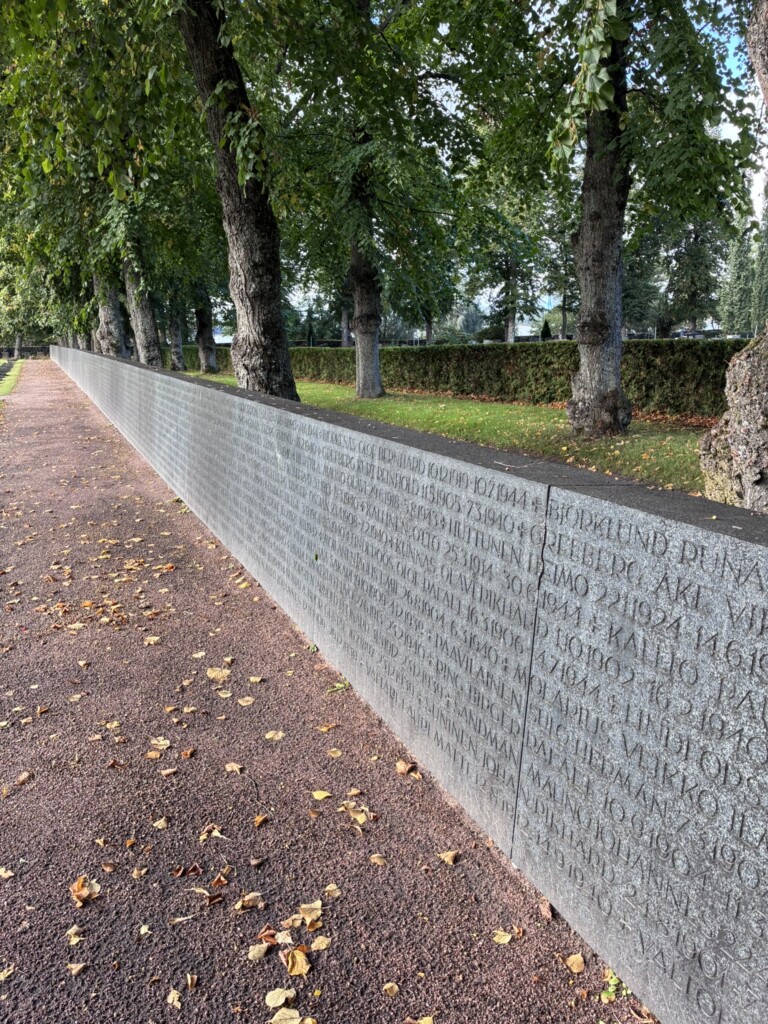
The Wall of the Missing at the Hietaniemi Heroes’ Cemetery in 2026. Photos: Anna-Mari Immonen, Finnish Heritage Agency.
Sources:
Online sources:
Helsingin seurakunnat – Hietaniemen hautausmaa(ulkoinen linkki) (24.9.2026)
Literature:
Kivimäki, Ville; Hytönen, Kirsi-Maria; Karonen, Petri; Malinen, Antti 2021: Sodat ja 1900-luvun suomalaisuudet. Sota kansallisten identiteettien rakentajana ja purkajana. – Teoksessa Pirjo Markkola, Marjaana Niemi, Pertti Haapala (toim.). Suomalaisen yhteiskunnan historia 1400–2000. Osa 2. Yhteisöt ja identiteetit. Vastapaino: Tampere, 441–472.
Kemppainen, Ilona 2006: Isänmaan uhrit. Sankarikuolema Suomessa toisen maailmansodan aikana. Bibliotheca Historica 102. Suomalaisen Kirjallisuuden Seura: Helsinki.
Savolainen, Ulla 2022: Muistin ideologiat, välineet ja puitteet. Inkerinsuomalaiset menneisyydet ja muistitieto museonäyttelyssä. Teoksessa Ulla Savolainen & Riikka Taavetti (toim.). Muistitietotutkimuksen paikka. Teoriat, käytännöt ja muutos. Suomalaisen Kirjallisuuden Seuran toimituksia, Nro 1478. Suomalaisen Kirjallisuuden Seura: Helsinki, 186–217.