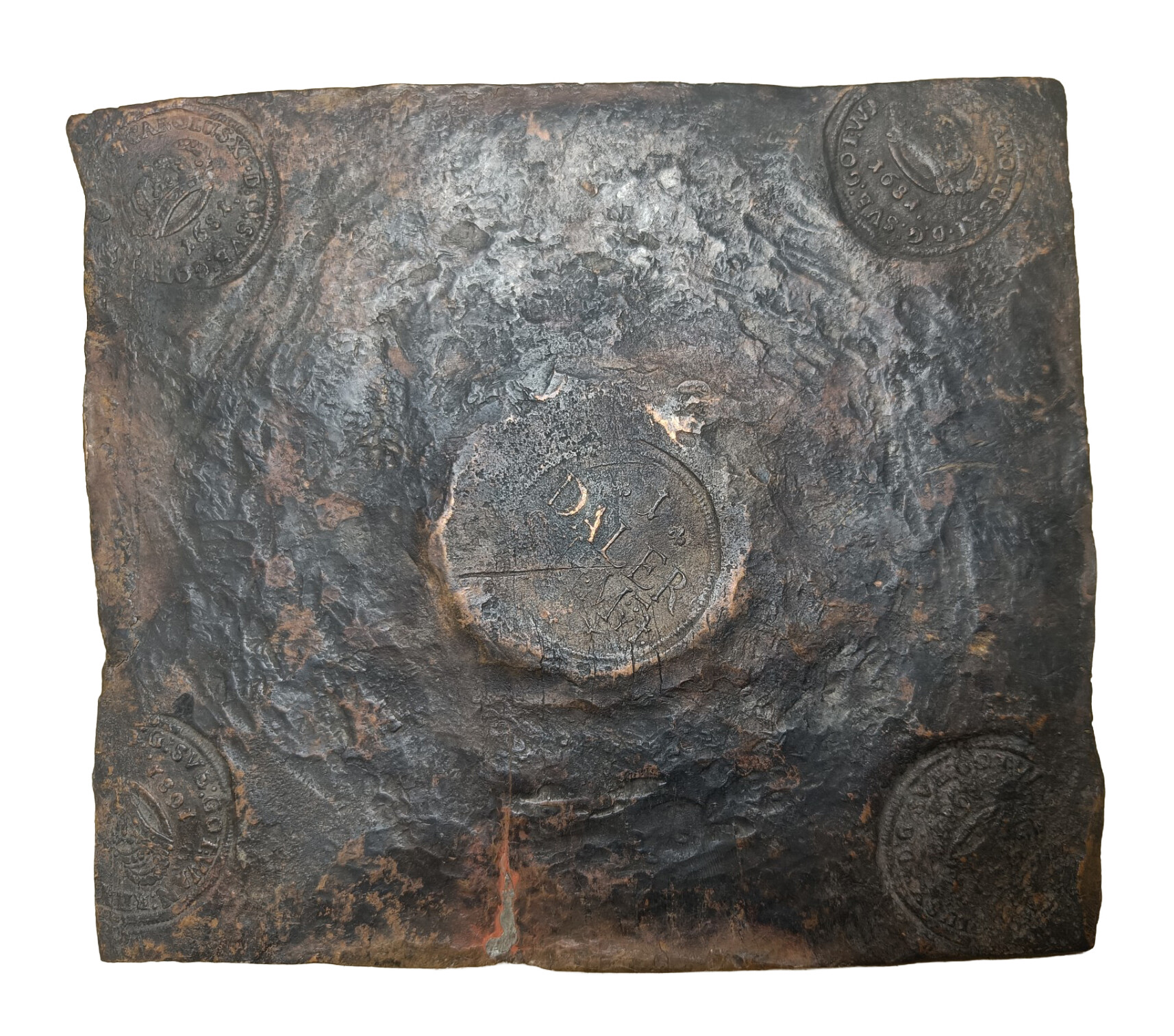
The plate coin from 1681 served both as currency and as part of a spittoon. It eventually ended up in the hands of a goldsmith, who in 1895 exchanged it for other coins with the Coin and Medal Cabinet of the University of Helsinki.
A Plate Coin from 1681
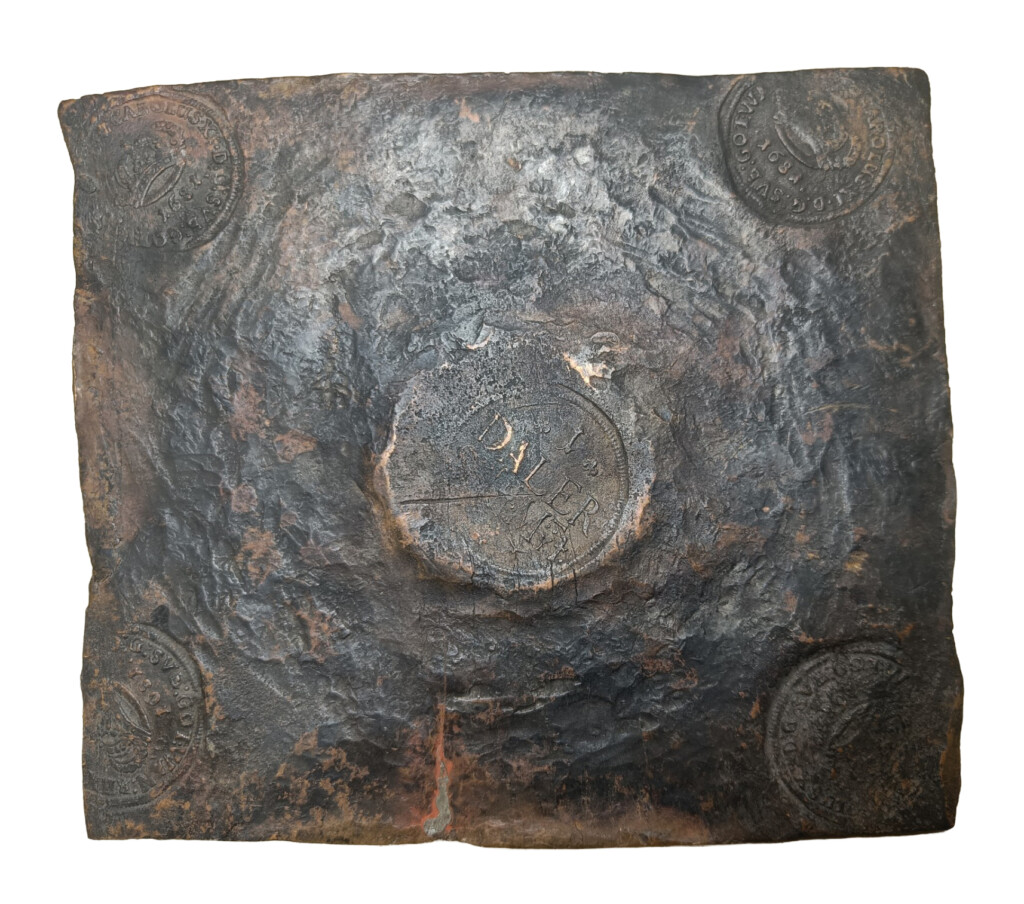
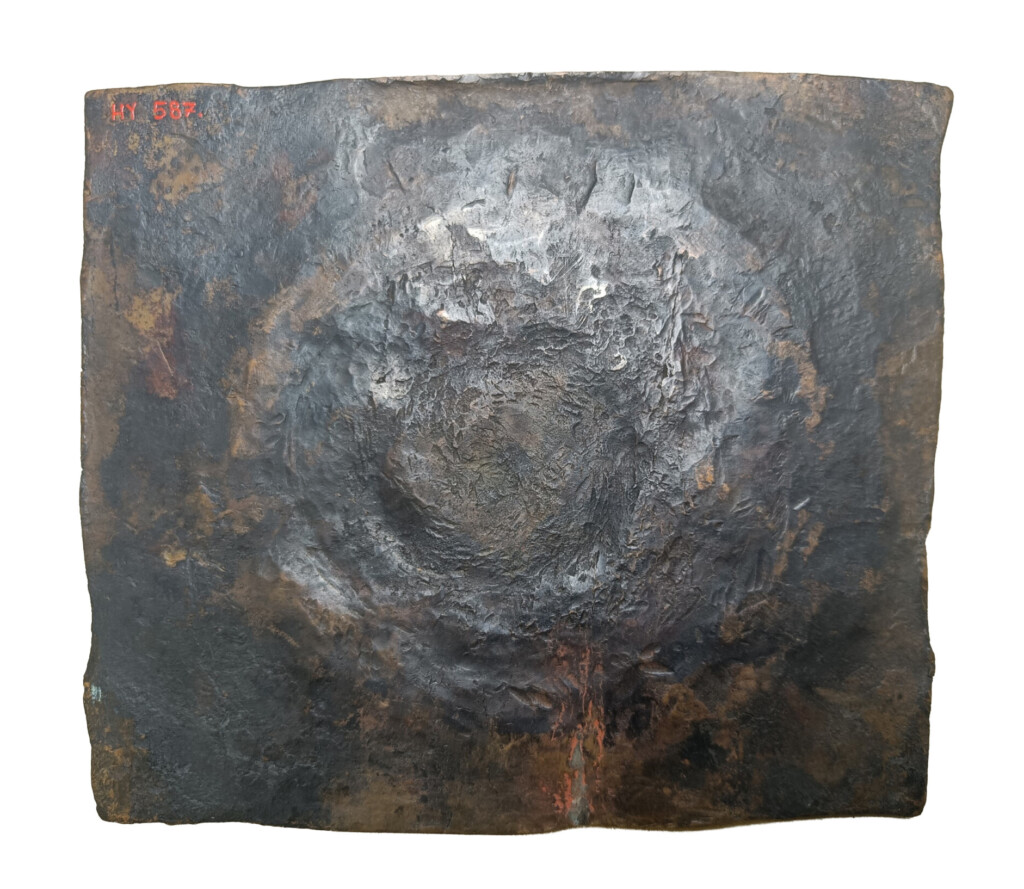
This month’s object is a one-daler piece of plate money struck during the reign of Charles XI of Sweden. It is a copper plate measuring approximately 17.5 × 19.5 centimetres and weighing around 1.4 kilograms. The round stamp in the centre indicates the value of the coin, while each corner bears the monarch’s title and the year.
According to the museum’s acquisition records, the plate coin comes from Ostrobothnia. After serving as currency, it acquired a new purpose there as part of a spittoon. Considering this later use, the coin has survived in surprisingly good condition.
The first pieces of plate money were struck in Sweden in 1644, when Sweden was one of Europe’s largest producers of copper. The value of plate money was based on the copper it contained, meaning that a high denomination also required a large copper plate. Large copper coins were proportionally cheaper to manufacture than small ones, while at the same time giving the copper a form suitable for export.
The largest pieces of plate money, with a denomination of ten daler, weighed as much as 19.7 kilograms and were rarely used in ordinary commerce. But one- and two-daler plate coins, produced from 1649 onwards, did circulate as currency. The last plate money was struck in 1776.
In 1681, plate money in denominations of eight, two, one and half a daler was struck to a total value of 580,350 daler. Despite this, few pieces from that year have survived, and this particular coin is also classified as rare.
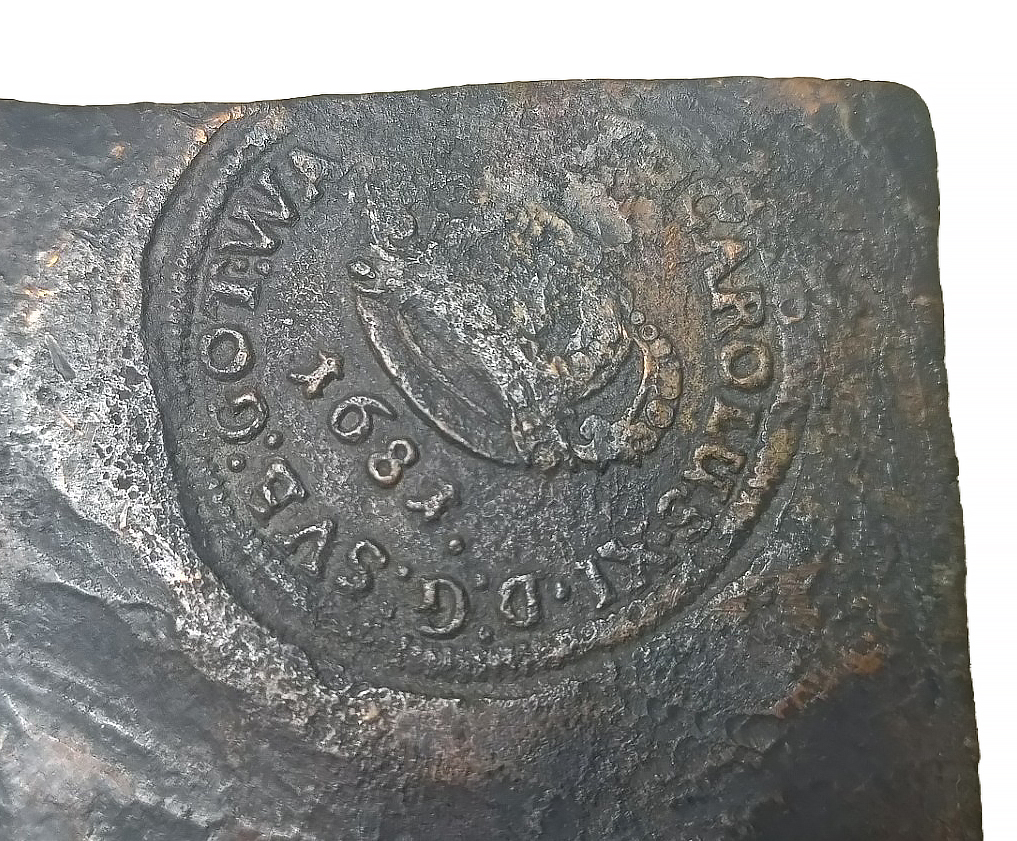
Rahan nurkkaleimoissa on hallitsijan tunThe corner stamps bear the monarch’s title CAROLUS·XI·D:G:SVECO:GOTO:WAN:REX, a crown and the year.
What Could You Buy with It?
Museums do not estimate the present-day collectors’ value of objects. What a coin could buy in its own time often tells us more about its history. In 1681, a one-daler piece of plate money could have bought, for example, a barrel of beer, a calf or a sheep – depending on the animal’s age and condition. It was by no means a fortune, but neither was it a trivial sum. We know that in 1684, a ten-year-old girl working as a maid in Eura received an annual wage of one daler in addition to her board and lodging.
Converting old money into modern currency is difficult, however, and one sometimes wonders how people managed to keep track of monetary matters at the time. The relative values of silver and copper fluctuated, and different systems for calculating the value of money were used side by side. Although plate money was made of copper, its nominal value was expressed in terms of silver currency. In Finland, and particularly in rural areas, however, values were primarily calculated in copper currency. In this system, one daler silvermynt was equivalent to three daler kopparmynt. Measured against the value of working time, the purchasing power of one daler silvermynt in 1681 would roughly correspond to about €750 today.
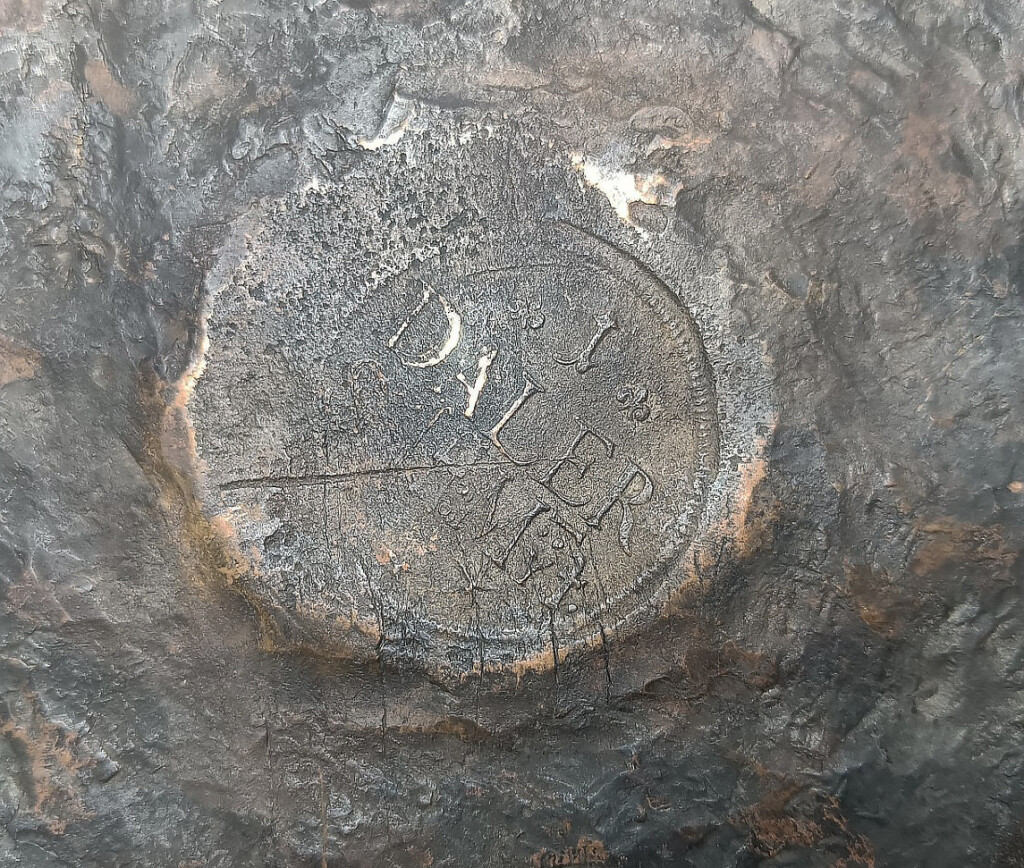
The central stamp gives the denomination as 1 DALER Sölff:Mnt.
How Was Plate Money Used?
Only a few contemporary descriptions of how plate money was used have survived. Pieces could be tied together with string, and plate money hoards have been found in wooden boxes and birch-bark wrappings. A few pieces could be carried in a backpack or birch-bark knapsack, but transporting larger sums required a sledge.
The weight of the plate money also caused practical problems. A tax collector working in northern Sweden complained in a letter to Queen Christina that he was unable to transport taxes paid in plates without a suitable means of transport. Around the same period, banks in Sweden began issuing credit notes and later transfer notes, which were considerably easier to transport. In Finland and the northern parts of the realm, however, banks were far away, and copper money was considered a more reliable alternative to paper currency. Wartime conditions and inflation in paper currency further increased the popularity of metal money.
Plate money was not only currency but also a valuable piece of copper. Its owner had the right to melt it down and reuse the metal. Plate money was probably used to make copper pans, cooking pots and other everyday objects. No definite evidence of this has survived, however, as it is difficult to determine the original source of the copper in a copper object.
This month’s object met a different fate. Rather than being melted down, the plate money was given a new life as part of a spittoon somewhere in Ostrobothnia.
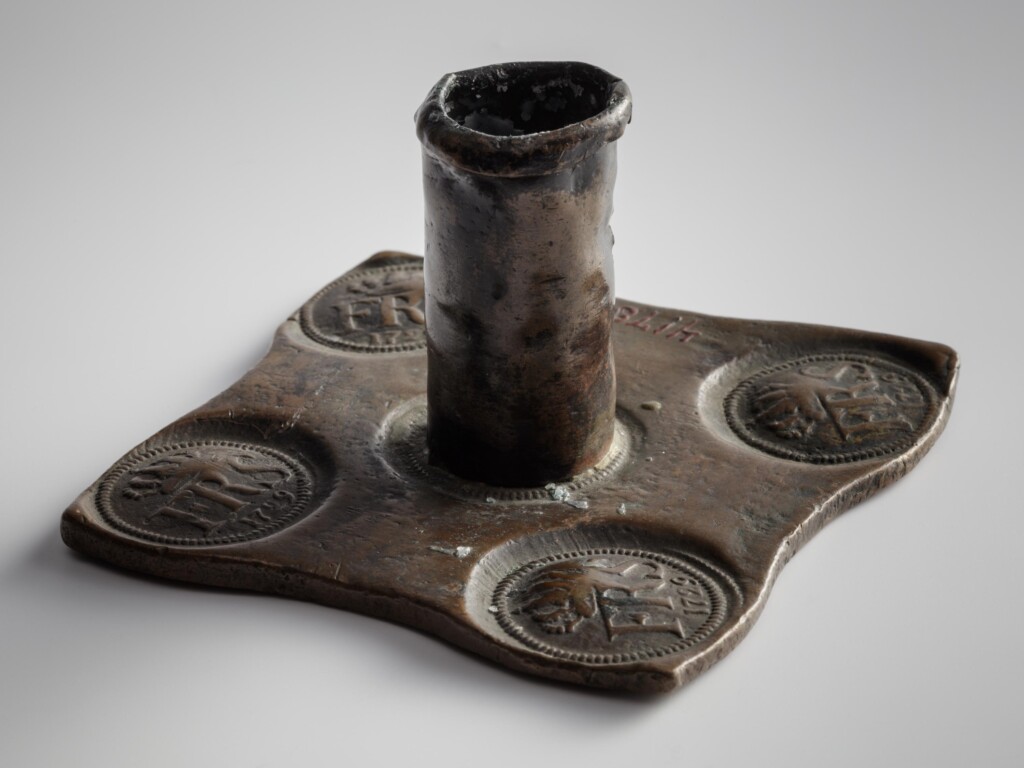
Plate money was reused in many different ways. The plate coin from 1729 shown here was given a new life as a candlestick.
The Plate Coin’s Journey to the Museum
In the late nineteenth century, the plate coin that had been used as part of a spittoon came into the possession of the goldsmith Karl Hägglund (1858–1914). In the spring of 1895, the Coin and Medal Cabinet of the University of Helsinki acquired it from Hägglund. In exchange for the rare one-daler plate, Hägglund received three two-daler pieces dated 1675, 1711 and 1718. They came from three coin hoards discovered in Ylikiiminki, Rovaniemi and Oulujoki in the 1880s. At the time, the one-daler plate coin from 1681 was the only known example of its kind, which explains why the collection was willing to give several other coins in exchange for it.
Exchanging objects was a common way of accumulate museum collections at the time. If a collection contained several examples of the same coin, duplicates could be used to acquire new objects. This practice continued until the 1960s.
Born in Sievi, Hägglund earned his living as a goldsmith but was also a coin collector himself. In the late nineteenth century, goldsmiths and merchants often bought old coins and other objects, including archaeological items found in the ground. Some were melted down, others were sold, and occasionally objects were offered to museums. In addition to this piece of plate money, the National Museum’s collections contain a number of other objects acquired through Hägglund.
The Coin and Medal Collection of the University of Helsinki was transferred to the National Museum in 1921. In 2022, ownership of the collection was officially transferred to the National Museum of Finland. The following year, it was moved together with the rest of the collection to the Finnish Heritage Agency’s Collections and Conservation Centre in Vantaa. After its long and unusual life, our piece of plate money is now safely stored there alongside 1,745 other pieces of plate money.
Sources
Edvinsson, Rodney & Söderberg, Johan: A Consumer Price Index for Sweden 1290-2008, Review of Income and Wealth, vol. 57 (2), 2011, s. 270-292
Lagerqvist, Lars O., von Heijne, Cecilia & Wisén, Ewa: Världens största mynt. Svenska plåtmynt 1644-1766. Kungl. Myntkabinettet, Sotckholm 2008.
Tingström, Bertel: Plate Money. The world’s largest currecny. Stockholm 1986.