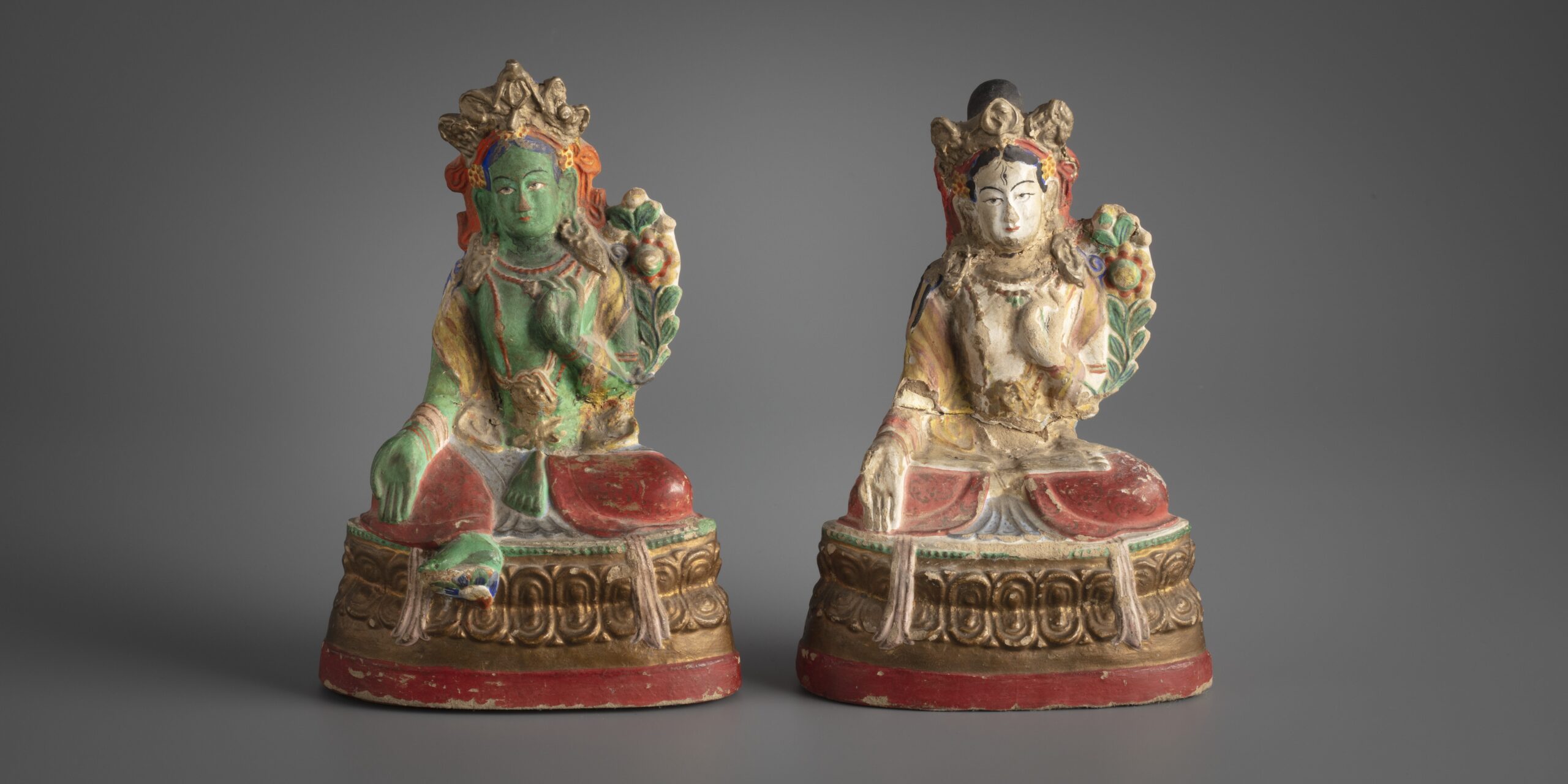
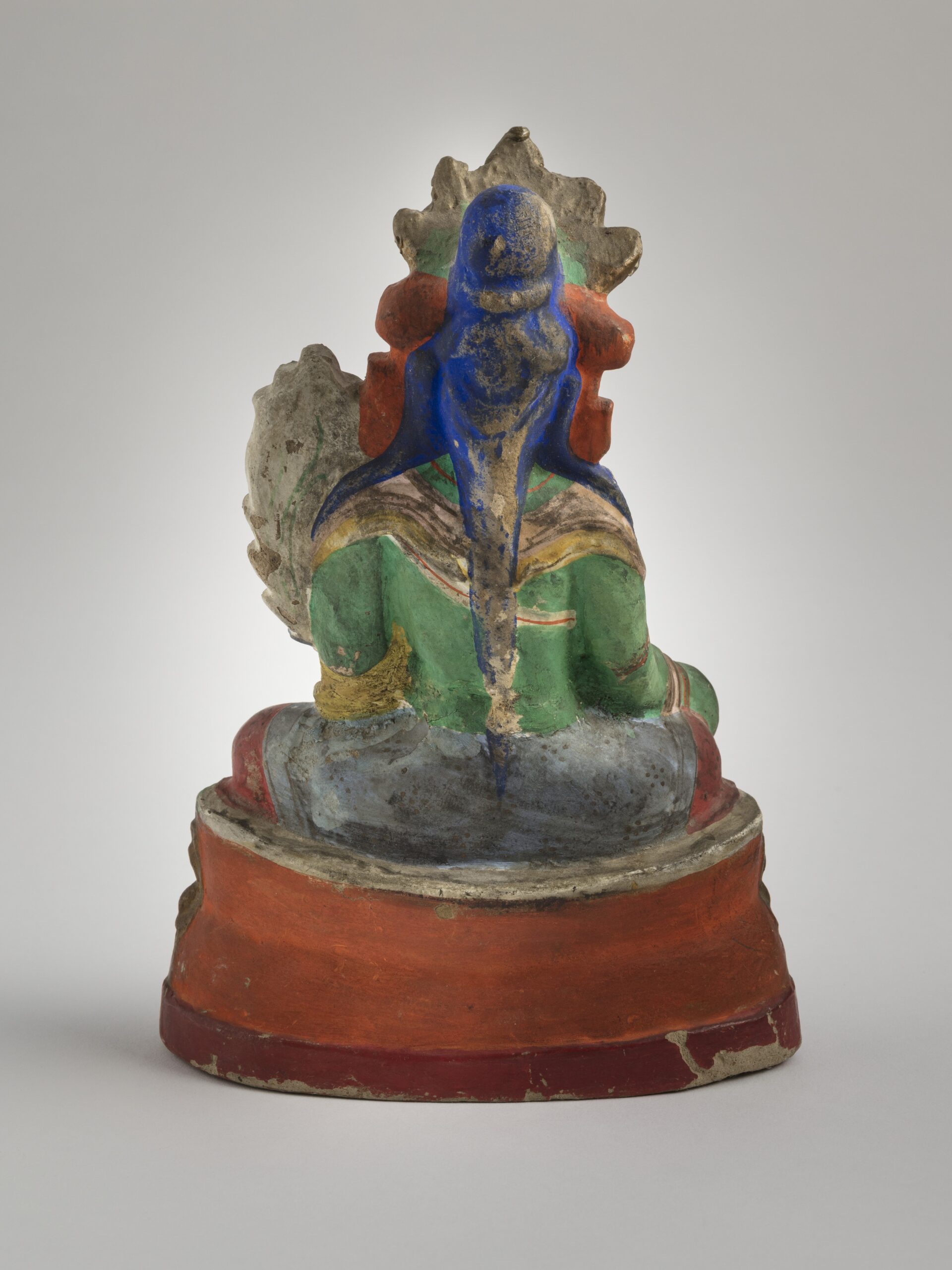
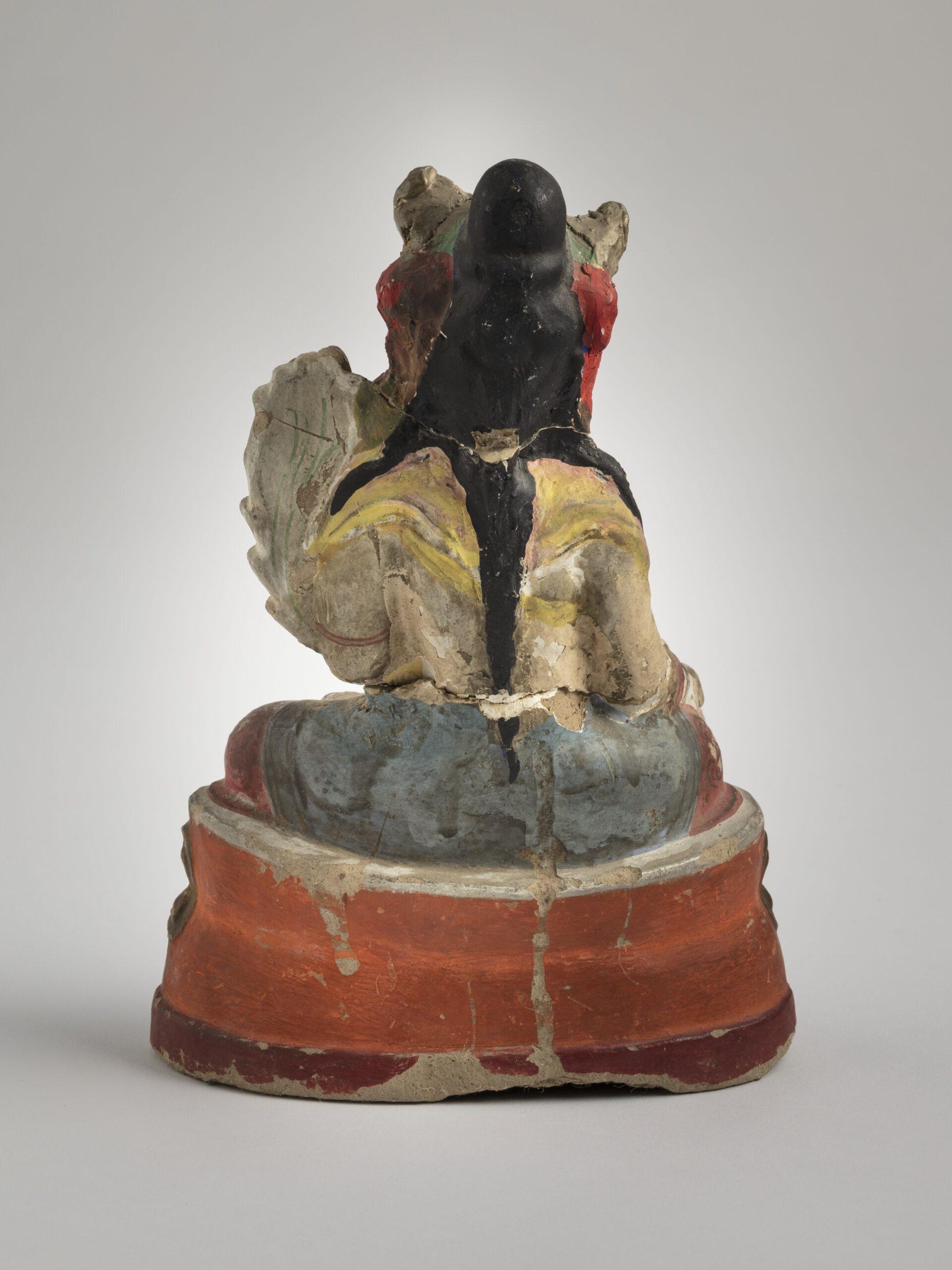
The object of the month is a pair of sculptures acquired in Ulaanbaatar, Mongolia in 1900 by the linguist G. J. Ramstedt (1873–1950). He presented them as a token of gratitude to his teacher, Professor Otto Donner (1835–1909), who had supported his research expeditions. Having remained in the possession of the Donner family for over 120 years, the sculptures were donated to the ethnographic collection of the National Museum of Finland at the beginning of this year.
Green and White Tārā
Charming despite their wear, these cast and painted clay sculptures depict the female deity Tārā, particularly venerated in Tibetan Buddhism (Vajrayāna), in her green and white manifestations. Tārā (Tib. Dölma, ‘the Saviouress’) is of Indian origin and, in Vajrayāna, is regarded as an emanation of Avalokiteśvara, the bodhisattva of compassion. Tārā is a meditation deity, a manifestation of enlightenment, and by contemplating her qualities, the devotee comes to understand the enlightened nature of their own mind.
Tārā’s attribute is the lotus flower, symbolising purity, which she holds in her left side with the left hand in a gesture signifying the transmission of the Buddha’s teaching. Her right hand rests against her knee in a pose representing compassion and the granting of wishes, with her fingers extended forward. Green Tārā is often depicted seated with her right leg lowered onto a lotus, signifying her readiness to hasten to the aid of those in need.
Green and White Tārā are linked to Tibetan history in an intriguing way. King Songtsen Gampo (605–649), who ruled in the first half of the seventh century, is believed to have had two wives: the Nepalese princess Bhrikuti Devi and the Chinese-born princess Wencheng. These noble consorts are thought to have been incarnations of Green and White Tārā, respectively, and Bhrikuti, in particular, who was regarded as the incarnation of Green Tārā, is considered to have played a significant role in the introduction of Buddhism to Tibet.
Ramstedt – linguist, professor and diplomat
The previous owners of the sculptures, G. J. Ramstedt, who brought them to Finland, and Otto Donner, who received them as a gift, were both among the most significant Finnish scholars of culture of their time.
Ramstedt’s life’s work was remarkably multifaceted, encompassing both linguistic fieldwork and a diplomatic career. In 1898, he studied the Hill Mari language in Central Russia and from there he travelled to Mongolia for three years – it was during this expedition that he acquired the Tārā sculptures. In 1903, he studied the Kalmyk language in the lower Volga region, and in 1904, Kumyk and Nogai Tatar in the Caucasus. He continued his studies of Kalmyk in Chinese Turkestan in 1905 among the Torgut Kalmyks. In 1909, he returned to Mongolia to study stone inscriptions together with the archaeologist Sakari Pälsi; he also recorded oral poetry, made phonograph recordings of songs and assembled a collection of objects for the National Museum of Finland, including over sixty Tibetan Buddhist thangka paintings.
Ramstedt studied Sanskrit and Greek as well as philosophy at the Imperial Alexander University (now the University of Helsinki), where he obtained his doctorate in 1903 with a dissertation on Mongolian verb morphology. He was appointed professor in 1917, but in 1919, he moved to a diplomatic career when he became Finland’s first chargé d’affaires in Japan. He was stationed in Tokyo until 1929, and he also studied the Japanese language.
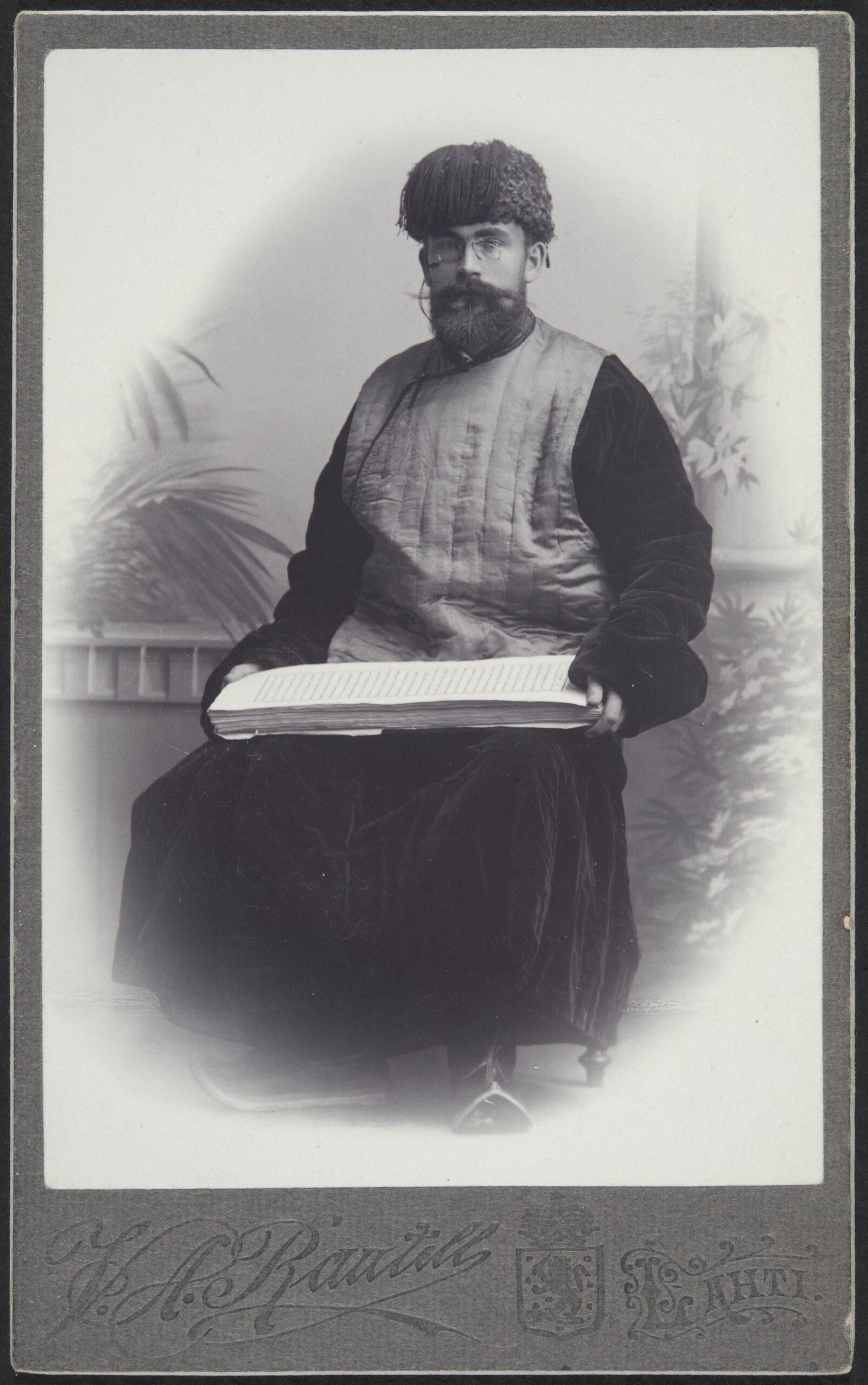
Photos:
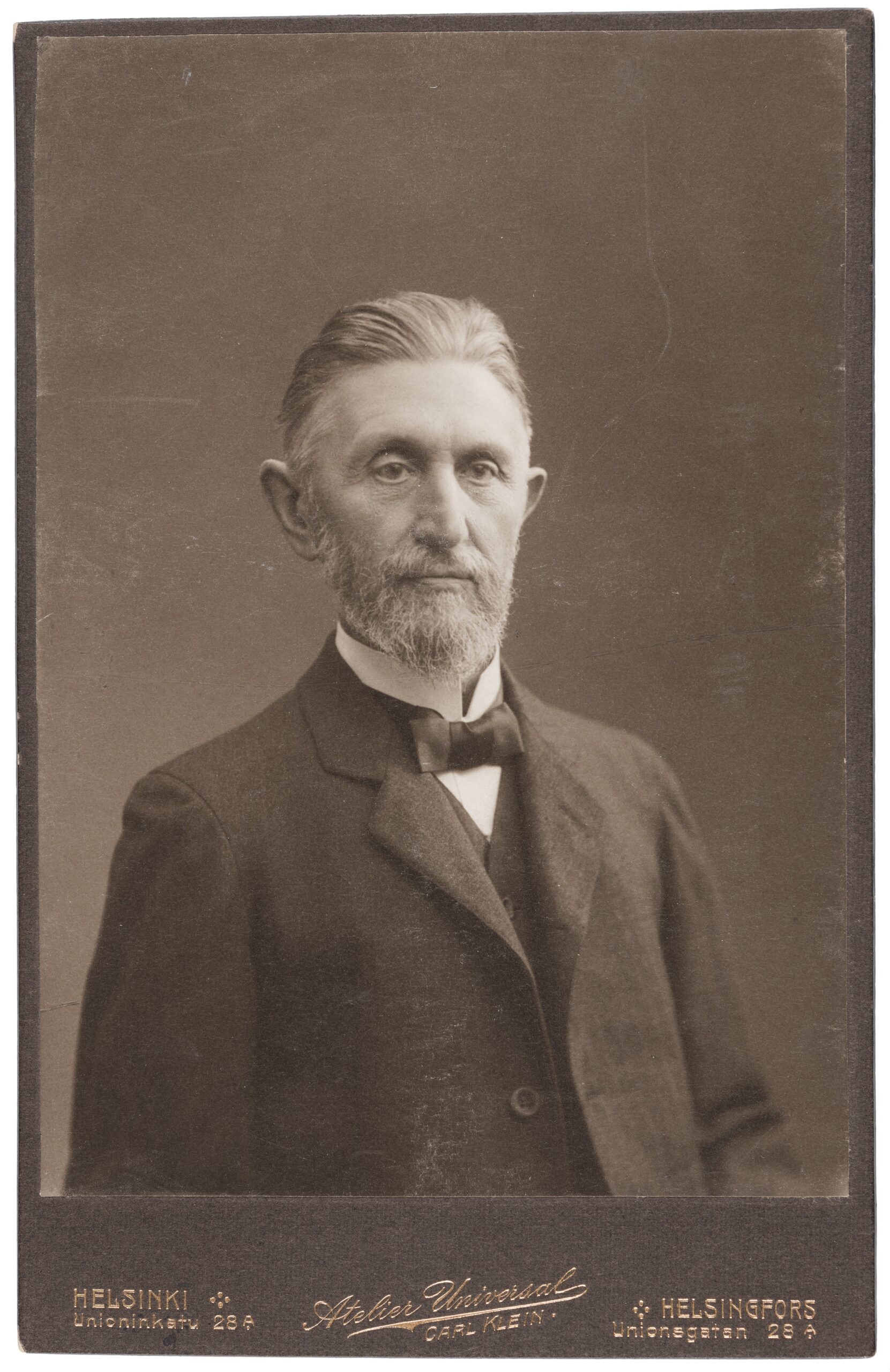
1. Otto Donner, member of the Diet and Professor of Sanskrit and Comparative Philology. Photo: Carl Klein, Atelier Universal, Helsinki, 1904–1909, Finnish Heritage Agency, Historical Picture Collection.
2. G. J. Ramstedt in Mongolian attire in the early 1910s. He was a scholar, diplomat and adventurer, a noted advocate of temperance and a skilled writer who, in addition to his scientific works, published the travel accounts Seitsemän retkeä itään 1898–1912 (Seven Journeys to the East 1898–1912) (1951) and Lähettiläänä Nipponissa. Muistelmia vuosilta 1919–1929 (As an Envoy in Nippon: Memoirs from 1919 to 1929) (1950). Photo: V. A. Rautell, Lahti, Finnish Heritage Agency, Historical Picture Collection.
Otto Donner, Professor of Sanskrit and Comparative Philology, had been Ramstedt’s teacher at university and assisted him as well as his other students in organising fieldwork expeditions. Alongside his teaching and research, Donner was a founding member of the Finno-Ugrian Society and held a leading position in the Finnish Antiquarian Society. He represented the clergy in the Diet of Finland from 1877 to 1905 and held numerous other public offices.
These two modest altar sculptures – Green and White Tārā – serve, in their quiet and poetic way, as a reminder of the life’s work of these two men and of earlier generations of scholars who opened new paths of research.
Pilvi Vainonen
More information
Otto Donner: Otto Donner – 375 Humanists(ulkoinen linkki)
G. J. Ramstedt: Gustaf Ramstedt – 375 Humanists(ulkoinen linkki)