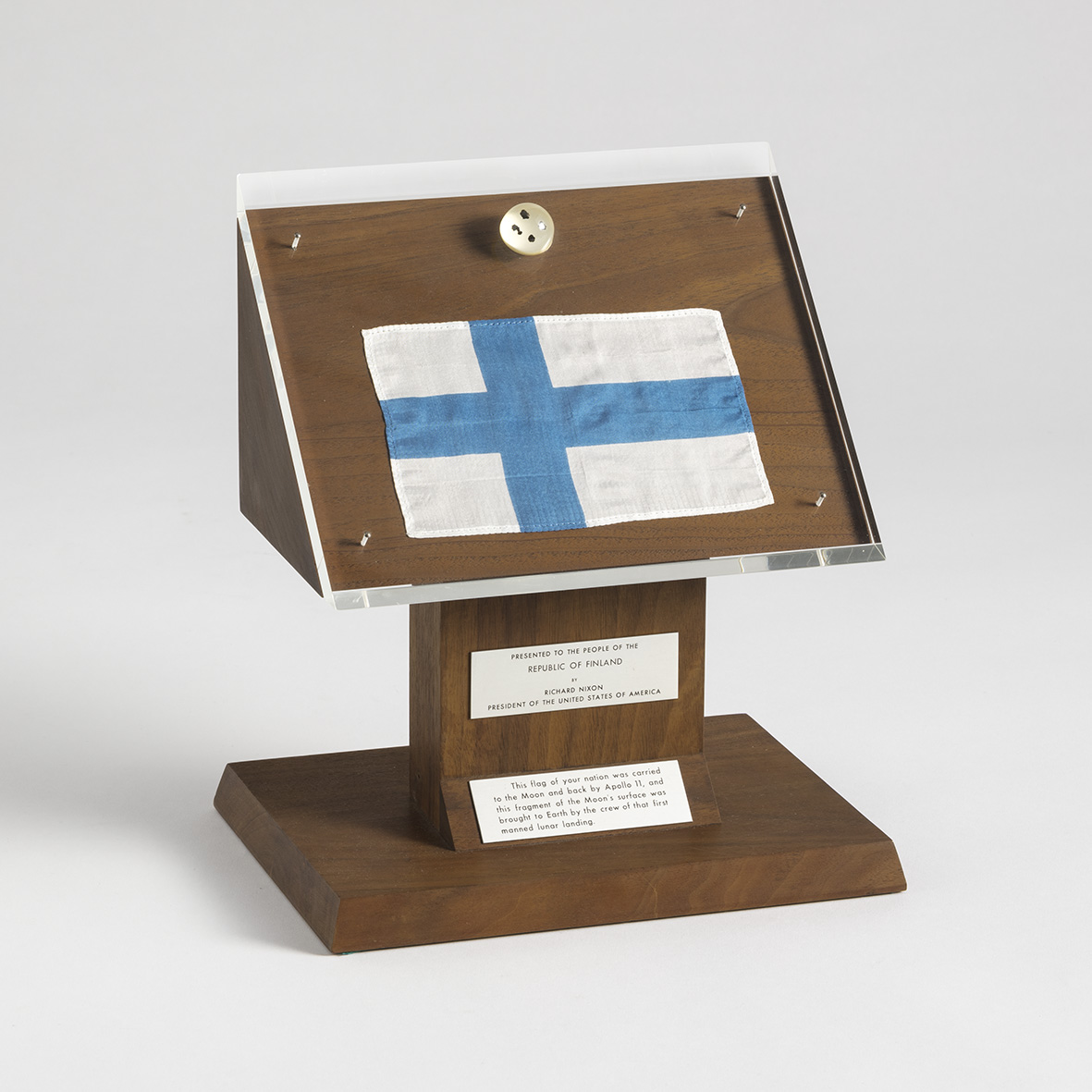
US President Richard Nixon donated moon rock samples collected during the Apollo 11 mission to numerous countries. Finland also received a sample, along with a Finnish flag that had been to the Moon.
Moon rocks for the people and for President Kekkonen
The Apollo 11 astronauts Neil Armstrong, Edwin Aldrin and Michael Collins brought back to Earth more than 20 kilograms of moon rocks for study. Like the astronauts, the rock samples were initially placed in quarantine. Once research was well under way, small samples were chipped from the rocks and sent to 135 countries as a gesture of goodwill and a publicity stunt.
The lunar samples sent in the name of US President Richard Nixon arrived in Finland in February 1970 with the astronauts of the Apollo 12 mission. President Urho Kekkonen accepted the valuable gift in his capacity as head of state. The astronauts then travelled to Romania to present a similar gift.
A dark wooden stand with legs contains four moon rocks, each about the size of a grain of rice, embedded in plastic, with a Finnish flag made of cloth beneath them. Attached to the base are two plaques stating that this is a gift from the President of the United States to the people of Finland and that the flag travelled to the surface of the Moon with the crew of the first crewed lunar mission.
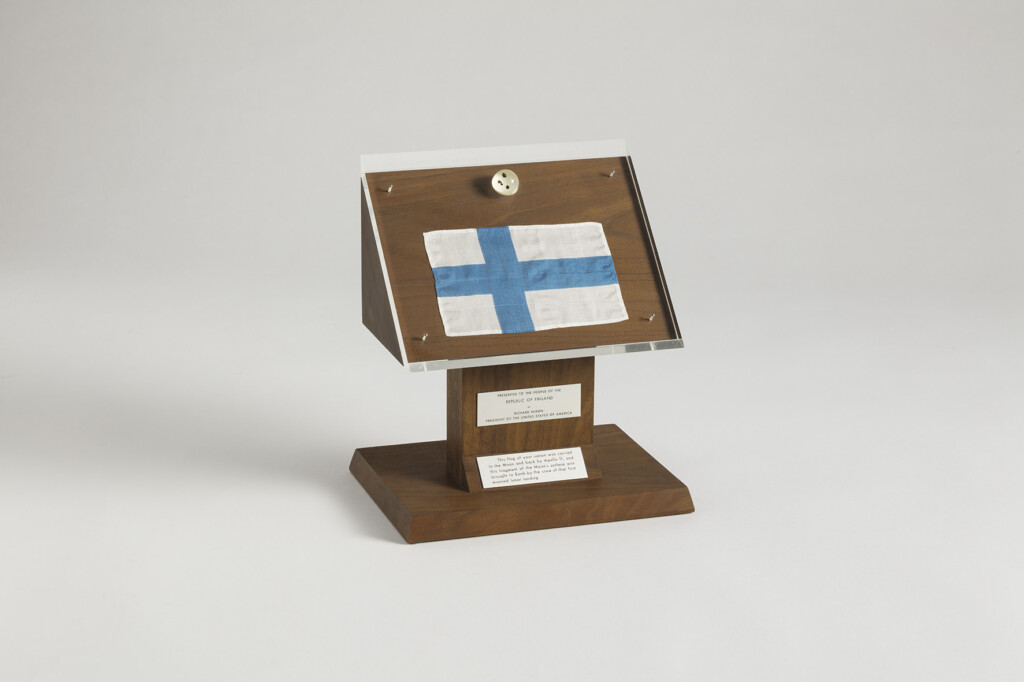
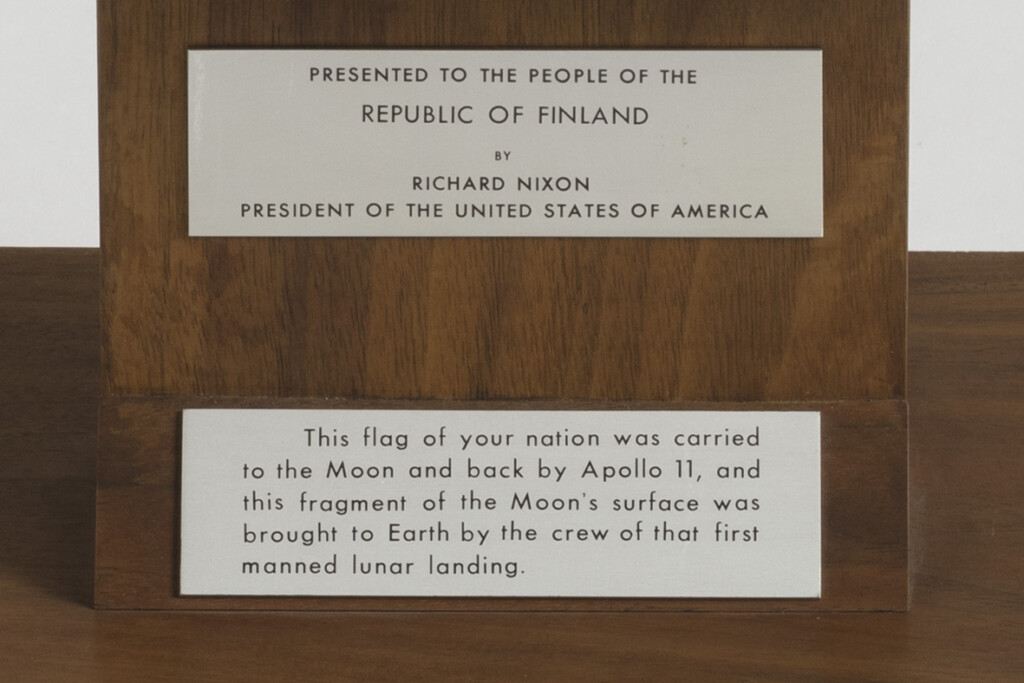
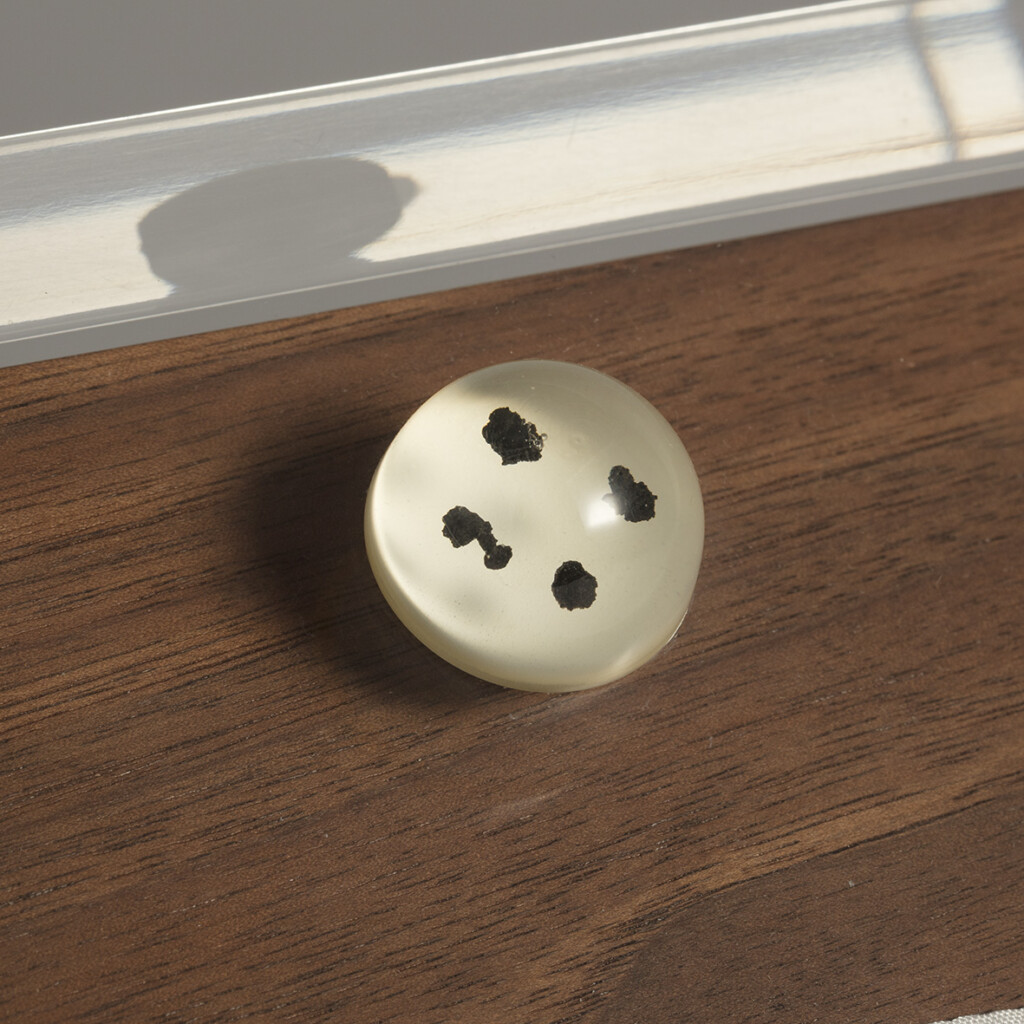
The artefact (H87100:591) is 28 cm high and 24 cm wide at the base. Photos: Finnish Heritage Agency.
Lunar samples as objects of interest
The moon rocks from the Apollo 11 mission have attracted widespread interest, and their history has been closely followed. The composition of the samples has been studied, including in the Netherlands, where Apollo 11 moon rock samples equivalent to the gift received by Finland were found to be genuine.
Of the 135 moon rock samples handed over to various countries, dozens have since gone missing, often as a result of social upheaval. Ireland’s moon rocks were destroyed in a fire in 1977, while the samples handed over to Afghanistan were stolen from the country’s national museum in 1996.
The rocks sent to Finland have been preserved among the state gifts received by President Urho Kekkonen as part of the collection of the National Museum of Finland.
The space race of the Cold War
The Soviet Union and the United States, the superpowers of their time, raced to conquer space in the 1950s and 1960s while also developing weapons technology. This was the Cold War era, when the rival Eastern and Western blocs sought to influence people by showcasing their cultural and scientific achievements.
The great powers used their space programmes as part of international communication and diplomacy. People followed these achievements with great enthusiasm. The Soviet Union made faster progress and succeeded in sending Yuri Gagarin into space as the first human in 1961. Gagarin was brought to Finland to be admired and celebrated less than three months after his historic space flight. The cosmonaut, who had become an international hero, had previously visited Czechoslovakia, Romania and Bulgaria.
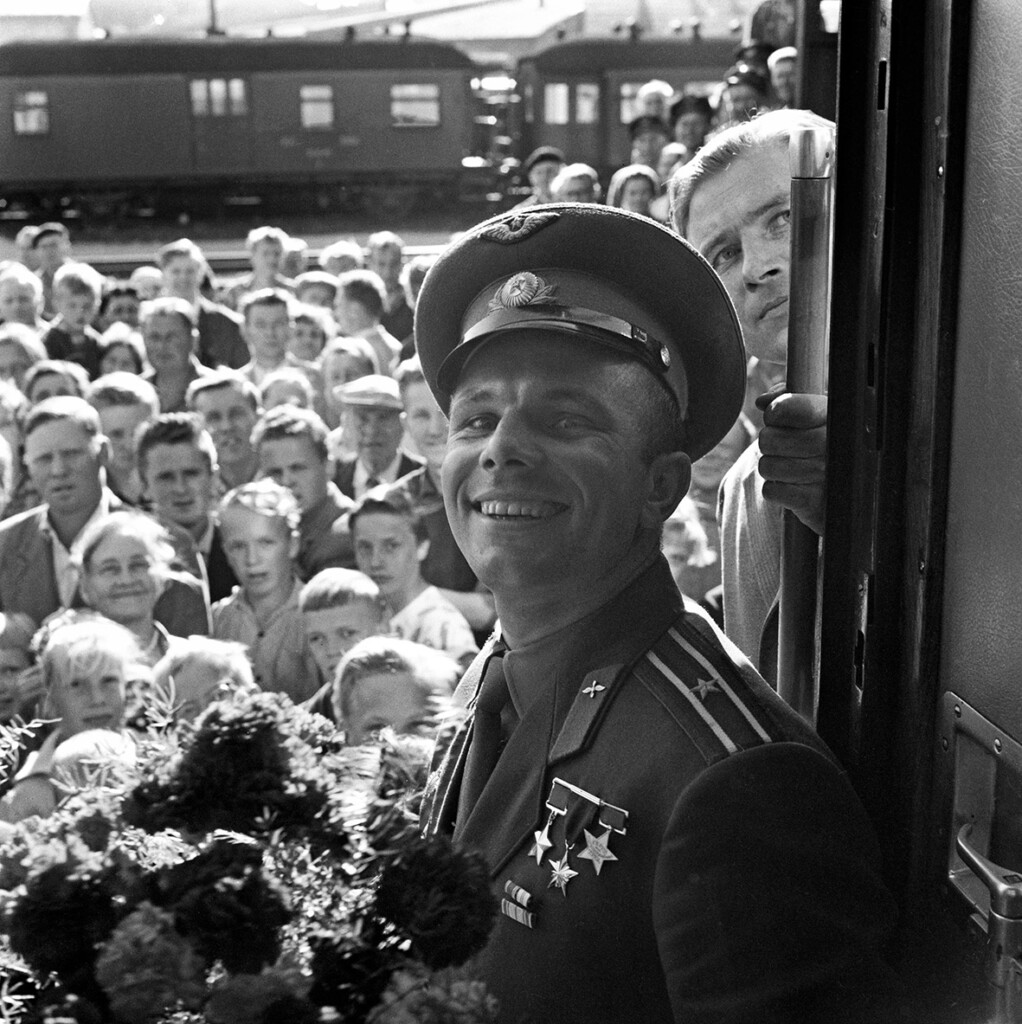
Cosmonaut Yuri Gagarin in Finland, June 1961. Photo: Press Photo Archive JOKA, Finnish Heritage Agency.
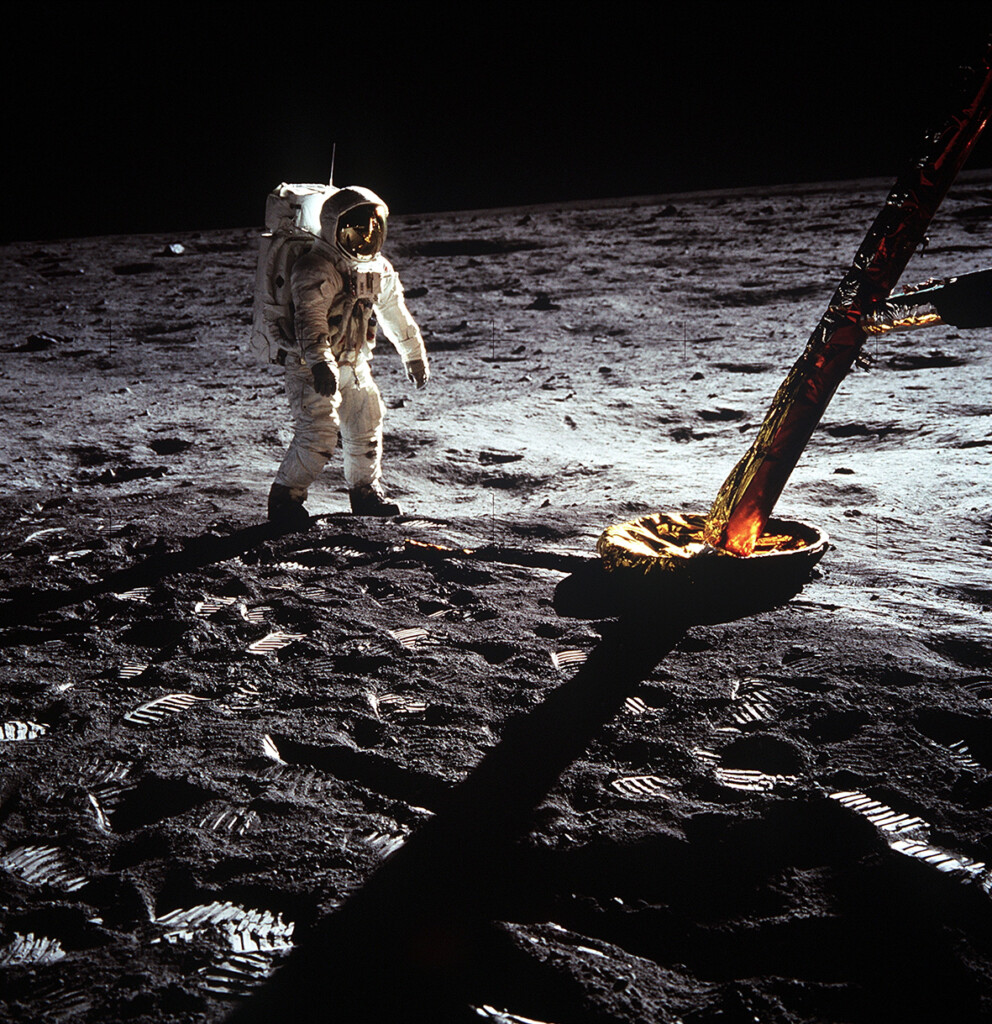
Astronaut Edwin Aldrin on the lunar surface, 20 July 1969. Photo: Neil Armstrong, NASA (ID: as11-40-5902)
However, the space race is generally regarded as having culminated in a victory for the United States, which succeeded in carrying out the first crewed Moon landing as part of the Apollo programme. Apollo 11 landed on the surface of the Moon on 20 July 1969. The visit to the Moon strengthened belief in humanity’s ability to achieve scientific goals that had once seemed impossible.
Maria Ollila
Further information
Compilation of Apollo 11 samples donated to sovereign states:
Collect Space – Where today are the Apollo 11 Lunar sample displays?(ulkoinen linkki)
Research article in the scientific journal Nature on Apollo 11 moon rocks preserved in the Netherlands: The Dutch Apollo 11 Goodwill display contains genuine Moon rocks(ulkoinen linkki)