The Napoleonic Wars culminated in a series of battles fought in 1814, in which Napoleon and the French forces under his command were defeated. The combined armies of Prussia, Russia, Austria and Württemberg fought the forces of the French Empire near Paris on 30 and 31 March 1814. The commander of the French troops was the Emperor’s brother, Joseph Bonaparte. Despite the city’s valiant defence, the French lost the battle and the Coalition armies marched into the city on 31 March.
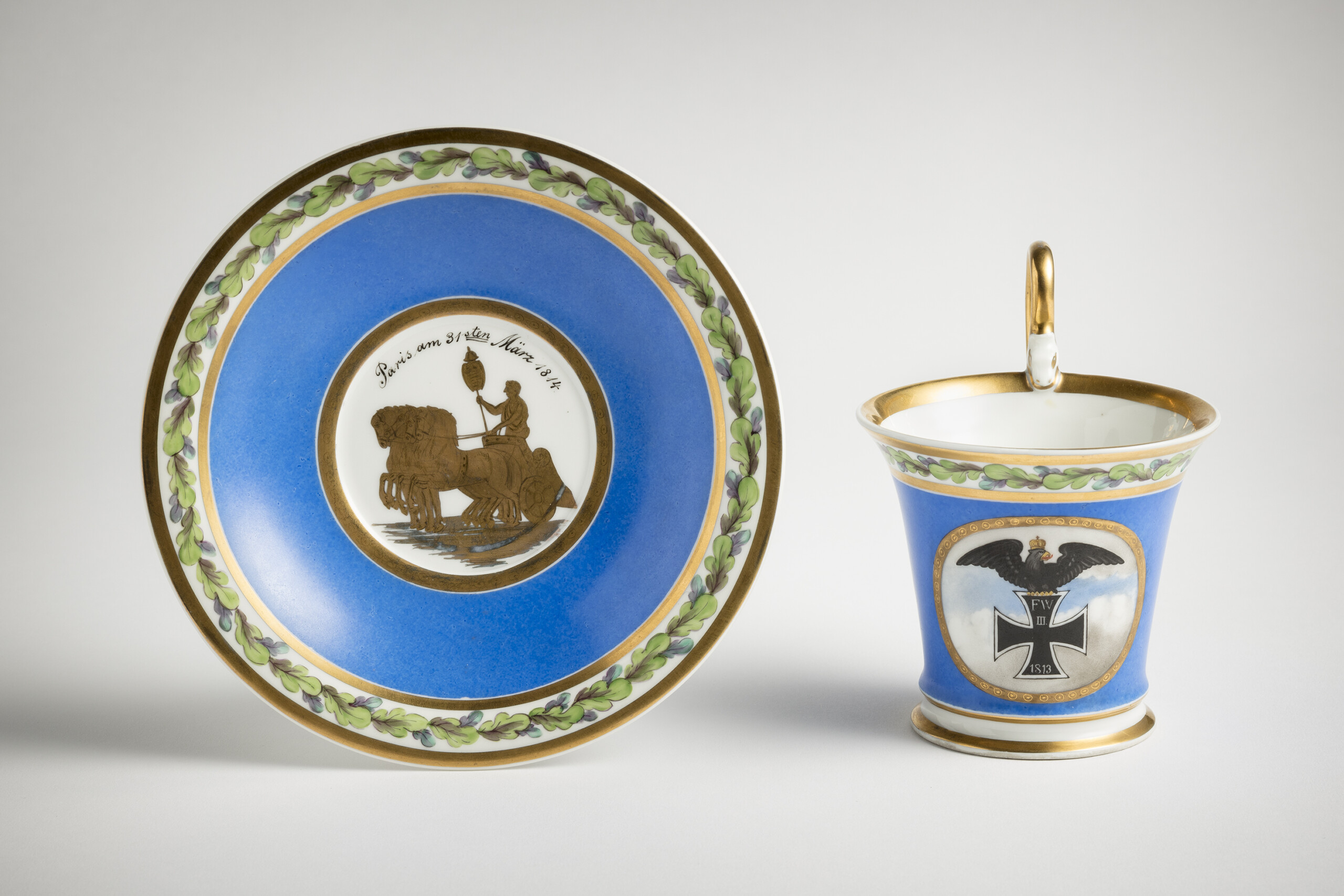
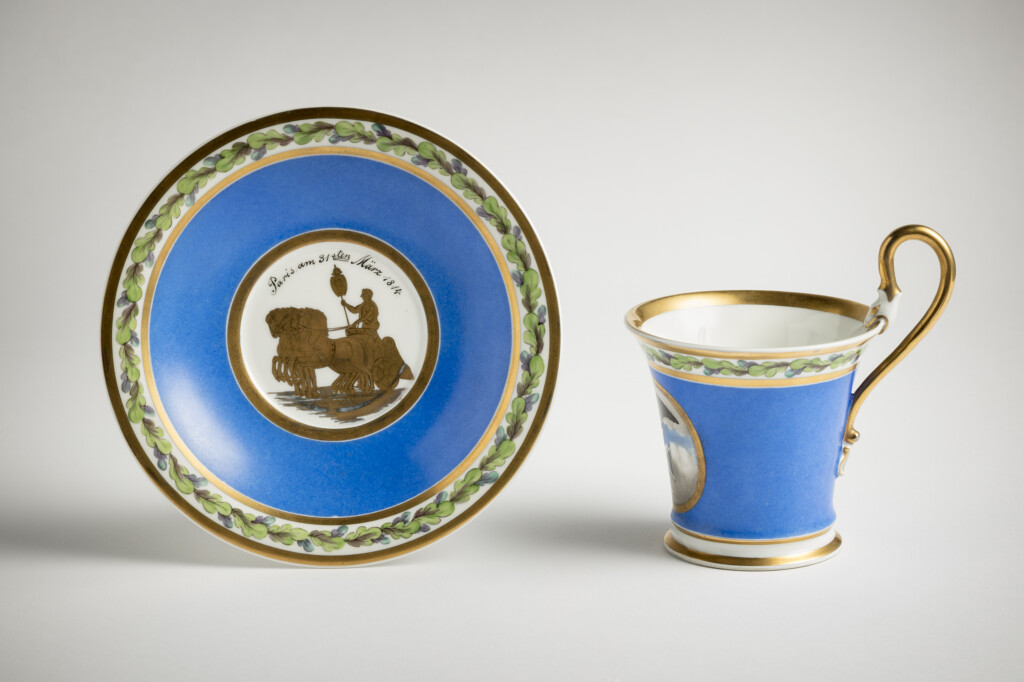
This coffee cup and matching saucer, produced by the Royal Porcelain Factory in Berlin, are representative of the Empire style of the early 19th century – a style that Napoleon had made fashionable during his reign as Emperor. The tall, sloping rim of the saucer, for example, is typical of objects from the early 19th century. The painted decoration on the cup depicts the Iron Cross, Prussia’s highest decoration, while the saucer has a painting of the sculpture standing atop the Brandenburg Gate in Berlin that portrays the goddess of victory driving a four-horse chariot.
King Frederick William III of Prussia established the Iron Cross award on 17 March 1813. As the decoration was awarded almost exclusively for military merit, the person who commissioned this coffee cup was most likely a Prussian officer who took part in the capture of Paris. The Iron Cross was modelled after the insignia of the Teutonic Order in the 13th century.
The Brandenburg Gate was commissioned by Frederick William III’s father and built between 1788 and 1791. The gate was erected at the site of the old city gate where Berlin’s main street, the Unter den Linden boulevard, ended and the road to Brandenburg an der Havel, the capital of the Margraviate of Brandenburg, began. The bronze quadriga, or a chariot drawn by four horses, crowning the gate was created by the sculptor Johann Gottfried Schadow. The quadriga depicted on the plate has been skilfully painted in gloss and matte gold and corresponds to Schadow’s sculpture down to the last detail. The image is bordered by the text Paris am 31sten März 1814.
At the turn of the 18th and 19th centuries, German porcelain was often decorated with bold colours and lavish gilding, as seen on this cup. Another characteristic feature of the period was the blue colour imitating the semi-precious stone lapis lazuli, which was a trend that had been adopted from France.
The French Revolutions of the 1790s also brought about changes in production at porcelain factories, as smaller orders from the wealthy bourgeoisie became more common, supplanting the multi-piece tableware sets and abundant decorative items previously commissioned by the nobility. A greater number of individual collector’s items and souvenirs were also produced for private customers than before. The decorative motifs on such items intended as gifts were often aphorisms or landscapes depicting cities, reminiscent of the stops made by young bourgeois boys on their study trips. The cup shown here undoubtedly belonged to a soldier who took part in the Battle of Paris, but it may not have been part of a set; rather, it is likely that it was an individual souvenir of the kind mentioned above.
Jouni Kuurne