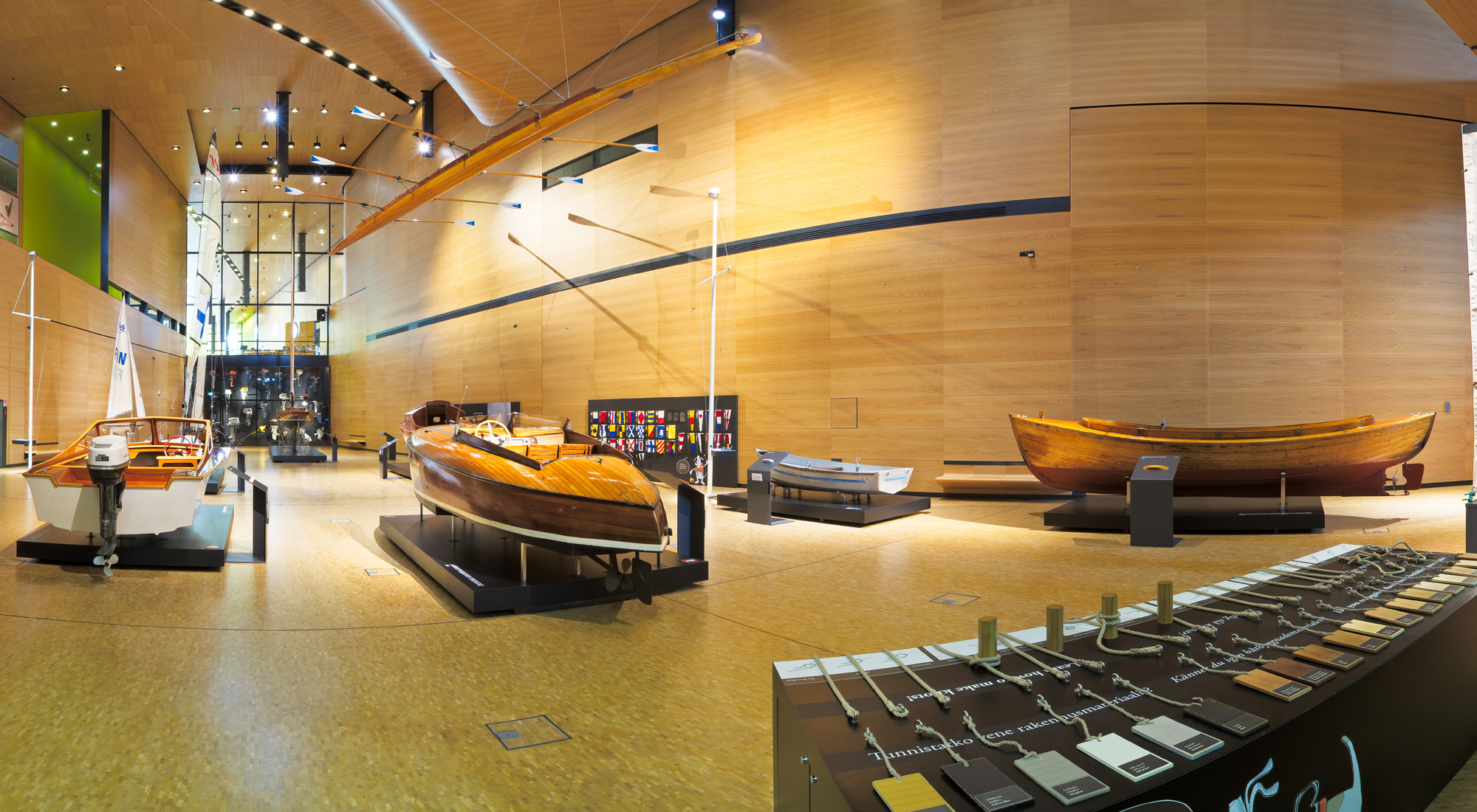
The national boat collection, which is managed by the Maritime Museum of Finland, includes over 100 workboats and recreational boats dating from the late 19th century to the 1970s. The list below presents a selection of boats from the Maritime Museum’s collections, arranged in chronological order. Some of the boats in the collection are on display in the boat hall at the Maritime Center Vellamo and in the outdoor exhibition area Kuuri, which is open during the summer. For more information, visit the Maritime Center Vellamo website.
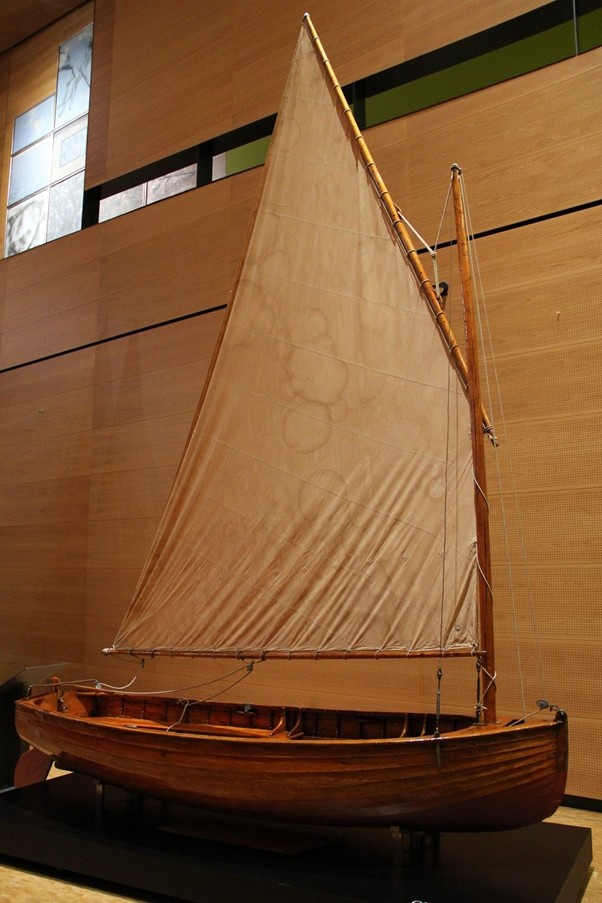
The catboat is a type of boat originally from the United States that also became popular in Finland in the late 19th century. Onni was acquired in the early 1880s by Anton Fredrikson, an industrialist and bank manager from Jyväskylä. The boat was likely built in the Viipuri region or on Lake Päijänne. It was named “Onni” after Fredrikson’s son. In the 1910s, the boat was purchased by artist Väinö Hämäläinen, who sailed the Onni on Lake Vesijärvi. After the artist’s death in 1940, the boat remained in the possession of his heirs and was last sailed in 1960.
The mailboat comes from Eckerö in Åland. An old mail route to Stockholm ran through Eckerö. The farmers of Eckerö were required to transport both mail and passengers across the Åland Sea to Grisslehamn, Sweden, in their own boats year-round. The most difficult and dangerous time for mail delivery was when there was pack ice and drift ice in the sea, or when the ice was only partially stable. At such times, small mail boats, so-called “ice boats” were used, which depending on conditions, were rowed, sailed, or pulled along the ice.
The boats had low sides, making it easy to jump into them if the ice broke. The last time the rural mail carriers delivered mail was in 1895. The system was officially discontinued in 1910.
The summer seine boat was built in 1895 in Luonnonmaa, Southwest Finland. This type of boat was developed in the parishes of the Turku archipelago for seine fishing for herring. Fishing took place in the summer at designated fishing grounds. The seine was lowered from the boat into the water in an arc. When the boat was rowed to shore, the fish were herded into the head of the seine. Reeling devices secured to the shore were used to help pull in the heavy seine.
Due to its flat bottom, the summer seine boat has a high load-bearing capacity, which was essential for transporting the heavy seine. Thanks to its shallow bow, the boat could navigate even shallow coastal waters. The seine boat was likely already known by the end of the Middle Ages. The use of the summer seine—and, consequently, the seine boat—declined dramatically in the late 19th century when the large trap was introduced for shore fishing of herring.
This three-masted driftnet boat was built in Merikarvia, Satakunta, at the turn of the 19th and 20th centuries. It is 8.5 meters long and 2.8 meters wide. The boat was owned by fisherman R. Lindblom.
Drift nets were used to catch herring on the open sea. Fishing always took place at night. The boat was sailed—or rowed in calm weather—to the fishing spot, where a line of nets joined together, known as a “jata,” was lowered into the water and secured at one end to the stern of the boat. The boat and nets were then left to drift with the wind and ocean currents until the nets, along with their catch, were hauled aboard in the early morning.
A drift net boat had to be easy to maneuver, as in calm weather it might be necessary to row as far as tens of kilometers to the fishing grounds or back to the home port. However, the boat also had to be spacious, as it had to accommodate a dozen large nets with their floats and weights, two men with their provisions, and the catch of herring on the return trip. With the advent of motorboats, open-sea fishing became both safer and faster.
Rudolf Ahonius, stationmaster at Suolahti, brought the first motorboat intended for recreational use to Keitele. The boat was built in 1906 at a boat yard in Turku. It was named Maija after Ahonius’s daughter. In the 1920s, Onni Virtanen of Suolahti bought the boat, which remained in use by his heirs until the late 1970s.
Maija’s hull is made of Oregon pine, and its deck is made of mahogany and pine. It is 7 meters long and 1.75 meters wide. The boat was equipped with a 3.5 hv gasoline-powered engine manufactured by the English company Fay & Bowen. The boat is 7 m long and 1.75 m wide.
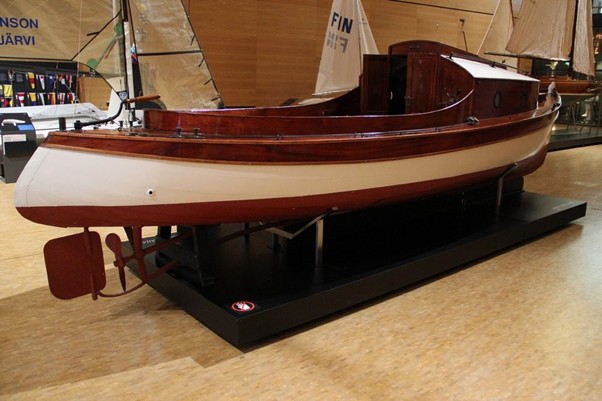
This seal-hunting boat was built in 1909 in Raippaluoto, Ostrobothnia. It belonged to Herman Österberg’s crew, which consisted of 3–4 men. The boat is 7.6 meters long and 2.32 meters wide.
Seal hunters from Ostrobothnia set out on hunting expeditions in early spring, which could last up to several months. The large seal hunting boat, along with its equipment, was hauled by horse to the edge of the fast ice, where the actual hunt on the ice began. The seal boats were pulled across ice floes or sailed in open water.
The large seal boat also served as a living quarters and storage base for the hunters. During the day, short hunting trips were made from it using a small boat and a ski-like craft known as an “ajopuu.” The small boat is 4.1 meters long and 1.48 meters wide.
This Kökar-style fishing boat was likely built in the 1920s. The exact date of construction or the boat’s original owners are unknown, but it appears that by the 1930s at the latest, it was owned by Forssell, a railway engineer who lived in Kauniainen. Mikko Lustig, who worked at the Kuggors farm in Sarvisalo, Pernaja, bought the boat from him. The Gestrin family purchased the boat from Lustig in the early 1950s and used it as a pleasure boat until the late 1960s.
The net boat was a common type of vessel used in the archipelago. Its primary use was for herring net fishing, but it was also used for trips to church and other journeys, as well as for transporting hay and leaves for livestock feed. During the Gestrin family’s ownership, the boat was converted into a motorboat, and a recess was cut into the stern to mount the engine.
The tarred boat is 5.1 meters long and 2.0 meters wide.
The archipelago cruiser Colibri VI was built in Helsinki in 1922 as a prize boat for the Helsinki-based Nyländska Jaktklubben sailing club. The boat belongs to the Nordic 22 m² class and was designed by architect Gustaf Estlander, one of Finland’s most famous boat designers. Colibri VI remained in service until the late 1970s.
The boat’s hull is made of mahogany and the deck of Oregon pine. It is 8.9 meters long (5.7 meters at the waterline), 1.9 meters wide, and has a draft of 1.4 meters. The boat has a lead keel weighing 1,000 kg.
The motorboat Frida was built for his own use by chief engineer Walter Eklund of Helsinki. The boat was launched in the spring of 1923. It is typical of the 1910s-style recreational motorboats. Walter Eklund also built the boat’s 2-cylinder, 8 hv engine. Today, the Frida is equipped with a Wickström 2-cylinder, 8 hv engine manufactured in 1946. The boat is 6.7 m long and 1.7 m wide.
Frida was mainly used in the archipelago off the coast of Porvoo. The longest trips taken on the boat extended as far as Turku and Kristiinankaupunki.
The iron pilot boat was built at the Ruona shipyard in Raahe in 1924. When Finland gained independence, the state had only a few pilot boats of its own. According to a report compiled in October 1926, of the 467 boats used by pilots, 383 were owned by the pilots themselves. During the 1920s, the number of state-owned pilot boats increased, and by the mid-1930s, most pilot stations had at least one state-owned motorboat.
An 8-meter-long and 2.35-meter-wide pilot boat was completed in the spring of 1924 and put into service at the Isokraaseli pilot station, located off the coast of Raahe. The boat’s first year, however, was tragic. The motorboat sank in the fall of 1924, and the pilot trainee who was steering it drowned. The boat was salvaged and, after repairs, served as a pilot boat until 1966, most recently at Martinniemi in Oulu.
In the 1960s, the boat was used by the Oulu Scouts and was subsequently privately owned. The Finnish Maritime Museum acquired the boat for its collection in 2002.
Once it was confirmed that the 12-foot dinghy class would be part of the sailing program at the Amsterdam Olympics (1928), Finland decided to prepare thoroughly for the Games. Sailing clubs in Helsinki built six dinghies of this type for training and qualifying races. The Finnish qualifiers were held on July 11–12 and were won by Bertel Broman of the Suomalainen Sailing Club in Helsinki.
The competition began on August 2, and the finals were held on August 7–8, 1928, on a triangular course in the Zuiderzee, which was sailed three times. Among the ten boats that advanced to the finals, the Nordic competitors performed exceptionally well. Sweden’s Sven Thorell won gold, Norway’s Henrik Robert took silver, and Finland’s Bertel Broman earned bronze. After Bertel Broman, the Olympic boat remained in private use until the early 1970s.
Compared to today’s lightweight boats, the 1928 Olympic boat is a sturdy wooden vessel. The boat is 3.66 m long, 1.4 m wide, and has a sail area of 9 m².
In the 1920s, there was no bridge connecting Kultaranta, the summer residence of Finnish presidents, to the mainland, so guests were picked up from Naantali by an open motorboat named Kultaranta. In 1929, a larger motorboat was commissioned and named Kultaranta II. The mahogany boat was built in Porvoo according to Gösta Kyntzell’s designs.
Kultaranta II has accommodations for a crew of two and ten passengers. The boat’s first engine was a 6-cylinder Schripps F-6 Junior Gold Cup, which propelled it to a speed of 30 knots. The boat’s current engine is a Ford V-8. Kultaranta II is 9.0 m long, 1.9 m wide, and has a draft of 0.8 m.
Presidents also used the boat on their archipelago excursions, and after the bridge was completed, Kultaranta II was used exclusively for recreational purposes. The Turku Naval Station was responsible for maintaining the boat. Sanoma Osakeyhtiö purchased Kultaranta II in 1978 and donated it to the Maritime Museum of Finland.
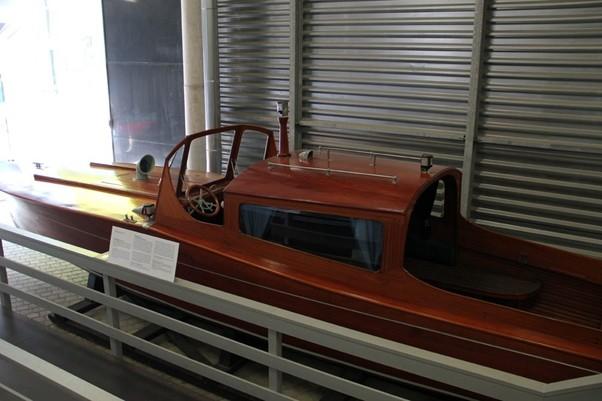
The boat was built in Suursaari in 1929. It was most likely built by a member of the Naski family of boatbuilders from Suursaari, possibly Uno Naski. Originally, the boat had a sail, but an engine was installed in 1933. The boat was used for trips to Estonia; herring was taken to Estonia and flour was brought back. In 1939, the boat was used for evacuation.
After the war, the boat was used in the Kotka area. In 1976, the boat was refurbished, and the old single-cylinder Wickström engine was replaced with an electric-powered two-cylinder Wickström engine. In the late 1970s, a cabin was also added to the boat. The boat remained in use until the early 1990s.
The boat is 7.7 meters long, 2.3 meters wide, and has a draft of 0.6 meters.
Tampereen Autokoritehdas built a speedboat designed by engineer Rafael Blomqvist in the early 1930s. The original intention was to mass-produce the boats, but only a few were ever built. In the 1930s, the boat competed in motorboat races, among other events, and during the war, it was used by the military as a transport boat on Lake Ladoga. Starting in the 1950s, the boat was used privately in the waters near Helsinki and on Lake Tuusula.
The speedboat was designed for 3–4 people, but when operated solo, it could reach speeds of up to 35 knots. The boat is 6 meters long and 1.8 meters wide. Its hull is made of mahogany and the deck of pine. The current engine is a 6-cylinder Hercules from the 1950s. The boat’s instrument panel and radio date from the 1940s–50s.
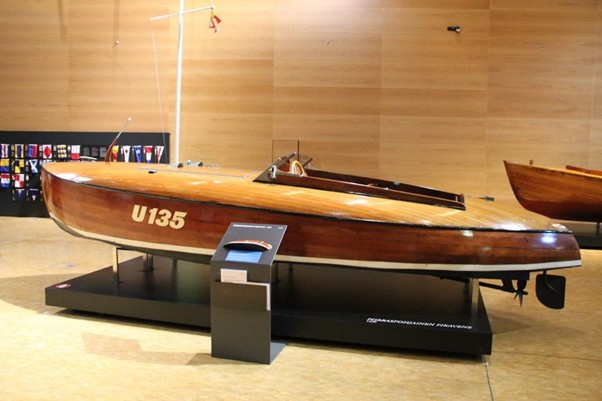
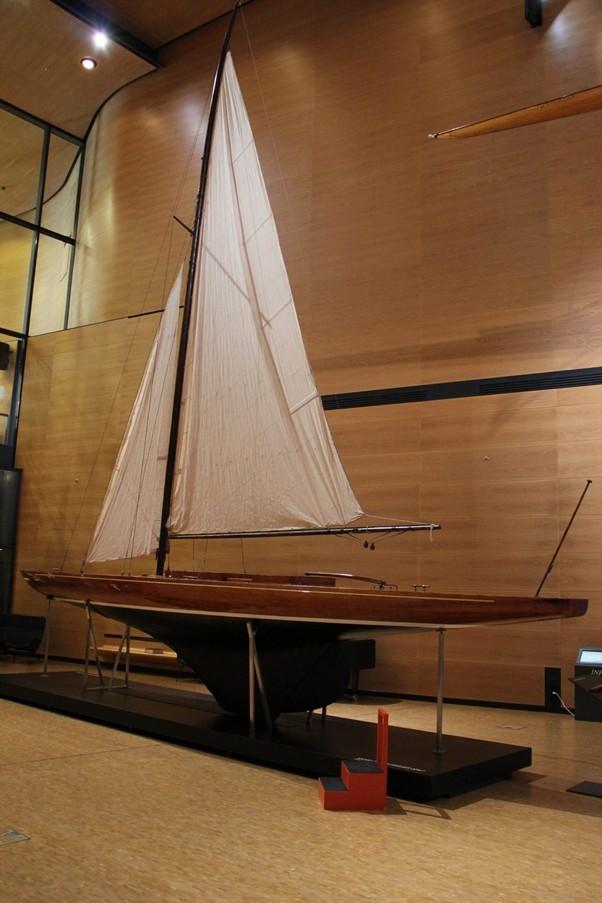
The Haivene Carina was built in Pyhtää in 1935 as a prize boat for the Kotka Sailing Club. Designed by engineer Gunnar L. Stenbäck, the Haivene was approved as an official racing class by the Finnish Sailing Federation in 1931, after which it quickly became the largest registered racing class until the early 1960s.
Its slender hull and small sail area made the Haivene an easy-to-handle and sufficiently responsive racing sailboat. The Carina, acquired by the Finnish Maritime Museum in 1990, has participated in racing events but has also been used as a family cruising boat.
The Haivene’s hull is made of pine and the deck of Oregon pine. It is 9.6 meters long (6.6 meters at the waterline), 1.9 meters wide, and has a draft of 1.1 meters. The boat’s sail area is 20 m².
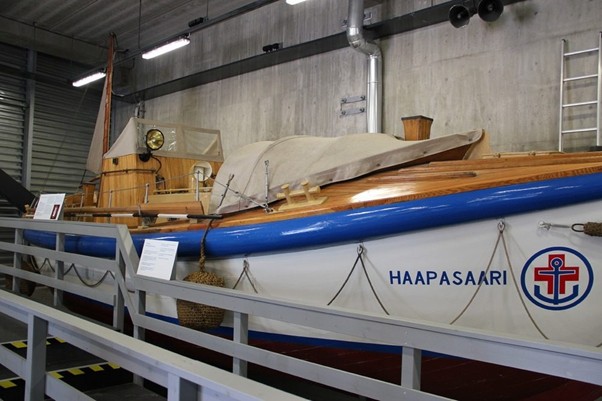
The boat was built at the Tolkkinen shipyard in 1937 as a rescue boat for the Haapasaari station. The Finnish Maritime Rescue Association commissioned the boat’s plans from Jaakko Rahola, a graduate engineer who had distinguished himself, among other things, as the chief designer of Finnish patrol motorboats. The Haapasaari was modeled after British vessel types. In addition to the Haapasaari, its sister ships Kokkoluoto, Ledsund, and Valsörn were also built.
The Haapasaari was in service in Kotka and Hamina until the late 1980s.
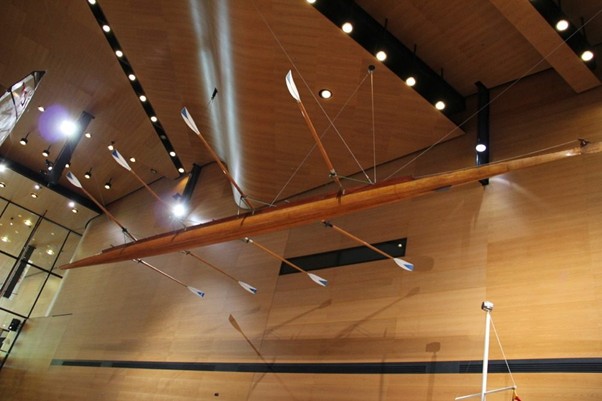
Built in 1951–1952.
Length 18 meters, maximum width 0.4 meters. Made of mahogany plywood.
This eight-man rowing boat was a standard racing model produced by the George Towns and Sons boatyard.
The boat, used by the coxed eight that represented Australia at the 1952 Helsinki Olympics, was christened “Australia” at its launch. The crew, which rowed to a bronze medal in the final, would have liked to keep the eight and its oars as a memento of the event. However, the manager of the Australian rowing team had decided otherwise—after the final, the eight was sold to the Porvoo rowing club Roddklubb AEB, which went on to win two Finnish championships with the boat. From AEB, the eight was passed on to the Neste rowers and from them to the Helsinki Rowing Club. The boat was last used in competition during the Helsinki Rowing Club’s 100th-anniversary regatta in 1985. The Helsinki Rowing Club donated the boat to the collections of the Finnish Maritime Museum in 2007.
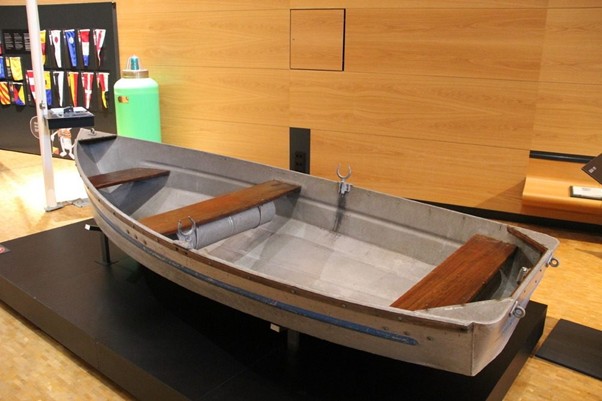
Year of manufacture: 1957.
Length: 3.2 meters, width: 1.3 meters, weight: 55 kg.
Material: aluminum; manufacturing method: welding.
Oy Kellokosken tehdas – Mariefors bruk Ab began operations in Kellokoski in 1896. As competition in the metal industry intensified in Finland during the 1950s, the Kellokoski factory also began looking for new products to add to its manufacturing lineup. Based on experiences and models from Sweden, England, and the United States, Finland’s first welded aluminum boat model designed for mass production, named Kello 1, was introduced in October 1955.
The factory had confidence in aluminum’s properties as a boat-building material. In 1961, the product catalog of Oy Kellokosken tehdas – Mariefors bruk Ab featured a total of 15 different aluminum boat models. The production lineup included rowboats, open outboard motorboats, windshield boats, as well as one sailboat model and a lifeboat.
By 1962, Oy Kellokosken tehdas – Mariefors bruk Ab had manufactured a total of 9,000 aluminum boats, 40% of which were sold abroad. In 1962, the factory was sold to Oy Fiskars Ab, which continued producing aluminum boats in Kellokoski until the mid-1970s. Under the new ownership, the aluminum boats became known under the Buster brand.
Gunilla Carlander-Reutenfeldt, M.A., acquired the Kello 1 boat on display while researching the history of boat production at Oy Kellokoski Factory – Mariefors Bruk Ab. The Kello 1 was found in the Sipoo archipelago. The boat, which had been unused for a long time but remained in its original condition, was originally purchased for use as a recreational boat in the archipelago.
The vessel was donated to the collections of the Maritime Museum of Finland by Gunilla Carlander-Reutenfeldt in 2005.
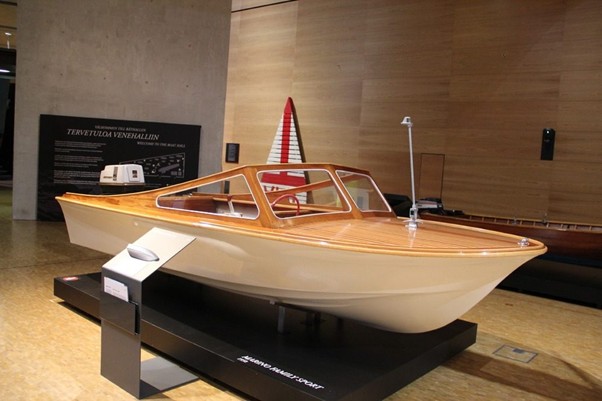
Marino Oy’s Family Sport model boats were introduced to the market in 1958. Approximately 30 of them were built until 1965. The boat in the Maritime Museum’s collection is the first of this model. It is 4.9 meters long and 2.05 meters wide. The following year’s model was lengthened, bringing the hull length to 5.10 meters.
In 1958, the boat was used by Tor-Björn Fagerström, the founder of Marino Oy. After that, it passed through several different owners until Marino Oy reacquired the boat and restored it for the company’s 35th anniversary in 1994.
Marino Oy began manufacturing fiberglass-reinforced plastic boats in 1958 and continues to produce motorboats today.
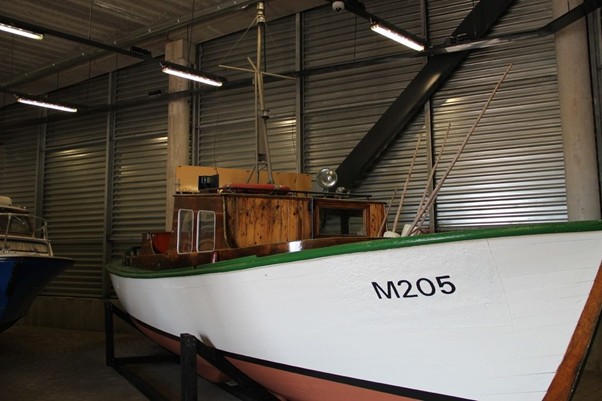
The hydrographic survey vessel M 205 was built in 1961 in Uusikaupunki. It represents the echo-sounder cutter type developed in the 1930s specifically for surveying shallow and rocky waters. M 205 was the last survey vessel of this type to be built. The boat’s standard crew consisted of a helmsman and a deckhand, but in practice, 3–5 men were on board during survey trips, including, for example, a survey chief, a sonar operator, two deckhands, and an engineer.
The vessel was first used under the name Kaiku 5 for hydrographic surveys in the Gulf of Bothnia. For most of its operational life, it was stationed on Lake Saimaa, where it served as the M 205 until the late 1980s.
The boat is 10.1 meters long, 2.5 meters wide, and has a draft of 0.8 meters. It is powered by a 3-cylinder, 4-stroke Volvo Penta MD 3 B diesel engine. The boat’s maximum speed was 8 knots.
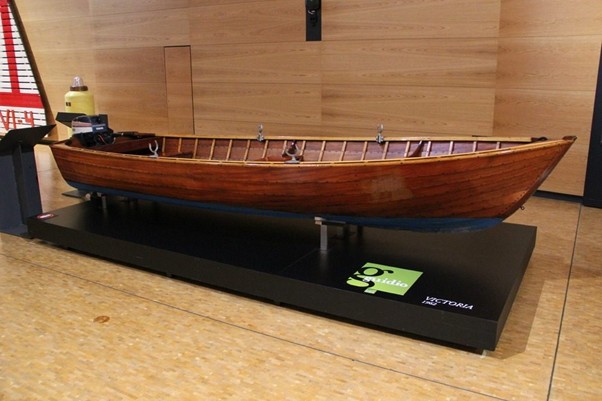
The Victoria was built in 1962 by Albert Gustafsson, a self-taught boatbuilder. Tove Jansson and Tuulikki Pietilä used the boat in Pellinge on the island of Klovharu for as long as they actively visited there. The boat was named Victoria because both Jansson’s and Pietilä’s fathers were named Viktor. “It was the most beautiful boat anyone had ever seen in the entire archipelago,” writes Tove Jansson in her book *Haru, an Island* (1996).
Victoria is a mahogany boat with clinker planking. It is 4.50 m long and 1.64 m wide. The outboard motor has been replaced several times during the boat’s lifetime. Most recently, it was equipped with a 10-horsepower Yamaha outboard motor.
The Sofa 15 De Luxe fiberglass boat was built in 1977, by which time fiberglass boats were already common in Finland. Their advantages were affordability and speed compared to wooden boats. The Sofa is equipped with a 20-horsepower Mercury outboard motor. The boat is 4.8 m long and 1.8 m wide.
The Sofa was owned by the Fahlenius family of Helsinki and was used for excursions in the archipelago near Helsinki. The boat was donated to the Maritime Museum of Finland in 1995.