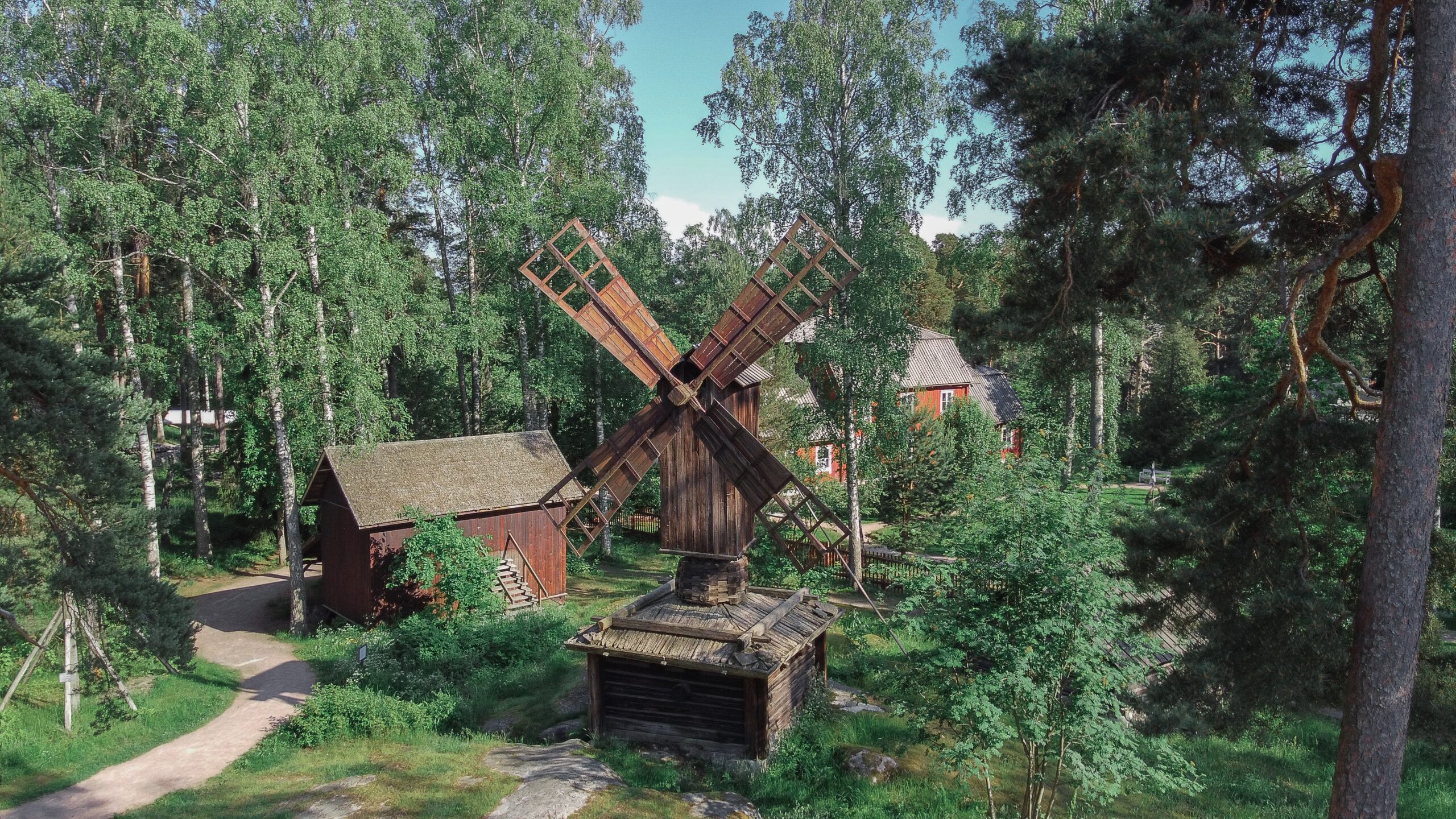
Seurasaari as a folk park
The Seurasaari Open-Air Museum was founded in 1909 on an island near what was then Helsinki. The island had been a popular recreational site among Helsinki residents since the 1890s.
Seurasaari originally served as pastureland for the Meilahti Estate, but came into the ownership of the City of Helsinki in the 1880s. The City sublet the island to Helsingin anniskeluyhtiö, a charitable non-profit organisation controlling the retail and serving of alcohol, which was tasked with establishing a folk park on the island. This folk park was intended specifically as a recreational venue for Helsinki’s working class.
The island became a popular recreational destination, and its services were developed by building facilities such as a restaurant, dance pavilions, a field for sports and events and a bathing area.
A steamboat first carried the visitors to the island. A dock was built for the boat at the southern end of the island, along with Isännäntalo, the home for the steward and guard of the island, which also doubled as the passengers’ waiting room. A bridge connection to the island was completed in 1882.
Idea for an open-air museum takes shape
The inspiration for the Seurasaari Open-Air Museum came from Sweden, where Stockholm-based Arthur Hazelius had founded the Skansen Open-Air Museum in 1891. Open-air museums were first established in Northern Europe, where wood was commonly used in construction, making it easy to disassemble and reassemble buildings. The establishment of an open-air museum in Helsinki was spearheaded by the ethnologist Professor Axel Olai Heikel, who also served as the museum’s first intendant.
The first building for the Seurasaari Open-Air Museum – a cattle shed from Maalahti – was purchased in 1906, even though the museum did not yet have a site at the time. The first proposed site for the open-air museum was Hesperia Park, an area on the outskirts of what was then the City of Helsinki. However, the park was deemed unsuitable due to its limited space and predominance of deciduous trees. A more natural environment dominated by coniferous trees was seen as a more preferable site for the open-air museum’s buildings that would be transferred to Helsinki from rural areas. A perfect spot was found in Seurasaari.
Open-Air Museum finds its home in Seurasaari
The Seurasaari Open-Air Museum opened in 1909, when the Niemelä tenant farm – moved to Seurasaari from Konginkangas – was opened to the public. The Seurasaari Open-Air Museum was founded before Finland gained independence, at a time when the views of Finnish identity and the history of the Finnish region were taking shape.
The founding of the museum can actually be seen as one way of shaping Finnish history, as the founders of the open-air museum intended to create a ‘miniature Finland’ that would showcase how people used to live in different parts of the Finnish countryside. The idea was to present the living conditions in the countryside and the traditional Finnish way of life to city-dwellers, in particular.
The Seurasaari Open-Air Museum experienced its most rapid growth during the first decades of the 20th century. This period of rapid growth taking place before the Second World War can be explained not only by the nationalist enthusiasm of the decades following Finnish independence, but also by the social changes of the 1920s and 1930s.
The early 20th century was a period of modernisation and growing prosperity in Finland, and many rural buildings underwent renovations such as installation of electricity and water pipes – or were even demolished completely to make room for new construction. Some of these buildings at risk of demolition found a new home at the Seurasaari Open-Air Museum.
Buildings from across Finland
Most of the buildings at the Seurasaari Open-Air Museum were selected for relocation to the museum on the grounds that they are representative of the housing culture of their home regions and demonstrate the rural way of life. Along with the buildings, some of the local items and belongings originally used in the buildings have also been moved to Seurasaari.
During the museum’s first few decades, the Karuna Church, the Ostrobothnian farmsteads Kurssi and Ivars, the Kahiluoto Manor from Southwest Finland, the Antti farmstead from Satakunta, and the Karelian Pertinotsa and Kaukola’s Niemelä buildings followed the Niemelä tenant farm to Seurasaari.
In the 1960s, the museum grounds were expanded with the relocation of the Selkämä Farm from Pieksämäki and the Halla House from Hyrynsalmi. In the 1980s, the old parsonage from Iisalmi and the Leppälä cabin were opened to the public. In 2002, two barns of the Savitaipale country store were moved to the museum.
The Seurasaari Open-Air Museum is a growing and evolving museum, and its newest selection of buildings showcases Finnish cottage culture. The Seurasaari Summer Cottage and its yard were opened to the public in the summer of 2026.