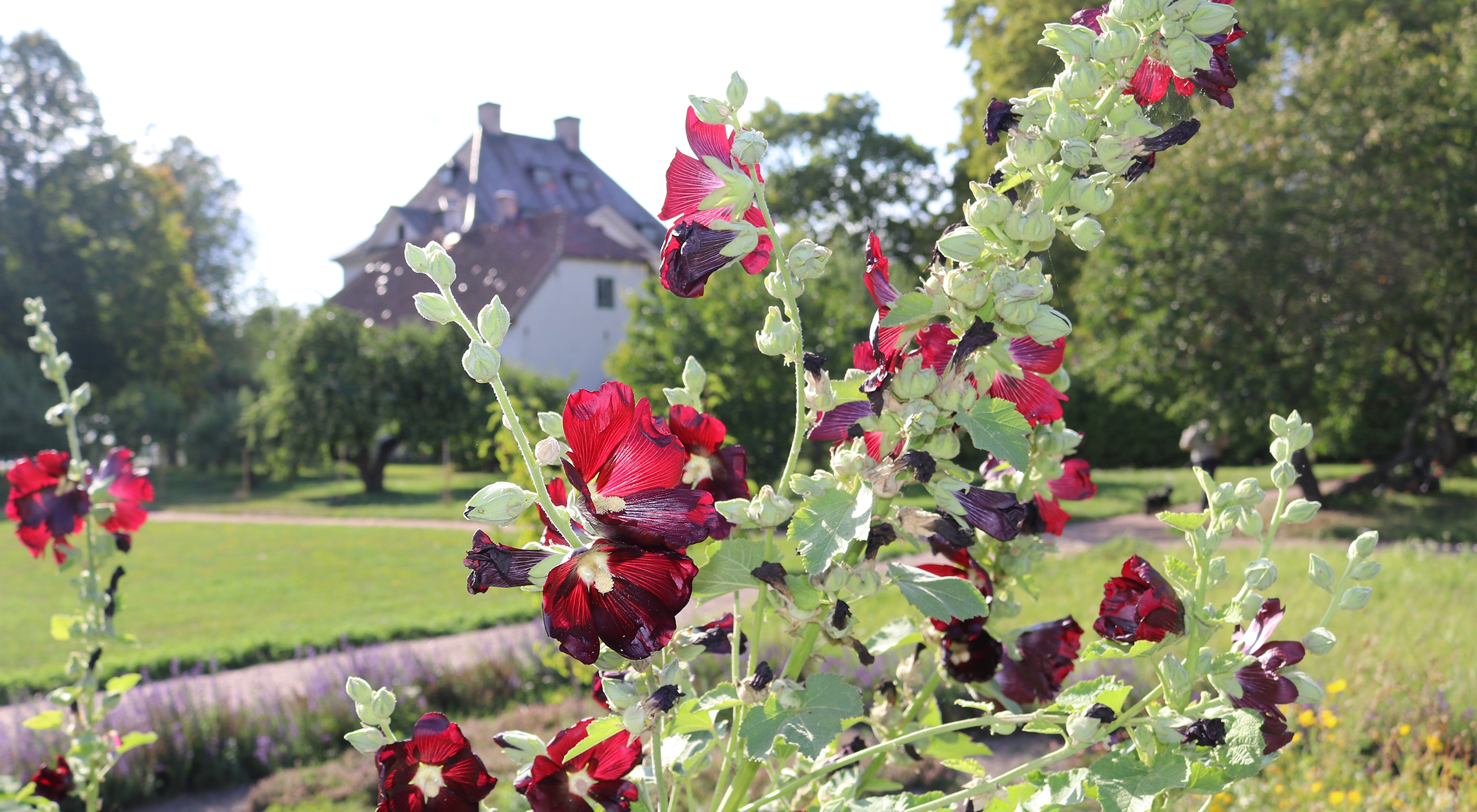
A Pehr Kalm-style kitchen garden
Since the summer of 2016, visitors to Louhisaari Park have been able to explore 18th-century useful and ornamental plants. Designed according to the teachings of Pehr Kalm, the garden embodies the ideals of the Enlightenment: all plants must be useful, but the garden must also be symmetrical, well-organized, and aesthetically pleasing. The plants in the garden originate from the Pukkila Manor in Kaarina.
The garden’s dimensions, structures, and design are based on Pehr Kalm’s 18th-century guidelines. Pehr Kalm was once Finland’s most internationally renowned scientist and the first professor of economics at the Academy of Turku. In a Kalm-style kitchen garden, symmetry and regularity were important, as was the fact that all plants could be used for food or medicine. On the other hand, beauty was also valued: the most beautiful and valuable plants were often placed in the foreground. The garden established at Louhisaari is located almost exactly where the manor’s own kitchen garden once stood.
The National Board of Antiquities was responsible for the design of the kitchen garden, and Senate Properties for the project’s implementation. Museum gardener Aaja Peura, M.A., served as an expert in the design process. She was also responsible for bringing the plants to Louhisaari in collaboration with the Natural Resources Institute Finland (LUKE) and the Livian Rural Institute.
The complex also includes Marshal Mannerheim’s playhouse, which was moved to the vicinity of the kitchen garden in the summer of 2016.
“The Mannerheim Apples” in 2017
In honor of the 100th anniversary of Finnish independence and the 150th anniversary of Mannerheim’s birth, Mannerheim apples will be planted in the garden of the Louhisaari Manor in 2017.
It is known that cherry trees, among other fruit trees, were already present in Louhisaari in the early 17th century. However, particularly during the time of Carl Erik Mannerheim at the turn of the 18th and 19th centuries, Louhisaari boasted a thriving kitchen garden where exotic plants were also cultivated. Louhisaari was also known for its apple trees.
Marshal Carl Gustaf Emil Mannerheim’s father, Count Carl Robert Mannerheim, and gardener J. Otterström announced in the Åbo Underrättelser newspaper in October 1870 the apple and pear varieties for sale at the Willnäs trädskola (Louhisaari nursery) in 1870 and 1871. The sales list included 24 different foreign apple varieties and five foreign pear varieties. In addition to these, berry bush seedlings were available for sale: red, yellow, and green gooseberries, as well as red, white, and black currants.
The Louhisaari orchard will be restored in the coming years using varieties from the 18th and 19th centuries. The goal is to create an apple orchard with as many different summer, fall, and winter varieties as possible.
Park
During the time of Countess Vendla Sofia Mannerheim, who was interested in gardening, the tree-lined path leading to the church was likely planted, and an “English landscape park” was created around the manor, complete with ponds and nature trails, which stretched through Myllymäki all the way to the so-called Paratiisinmäki. Visitors can still visit Myllymäki today if they wish. The current park pavilion on the shore was built according to A. F. Granstedt’s drawings in 1825; it originally served as a bathhouse.
The park was renovated in the 1870s and 1880s according to a plan drawn up by the Paludan & Stenius gardening firm in 1874. The main part of the current park, which includes gray and balsam poplars as well as an apple orchard, dates from this period.