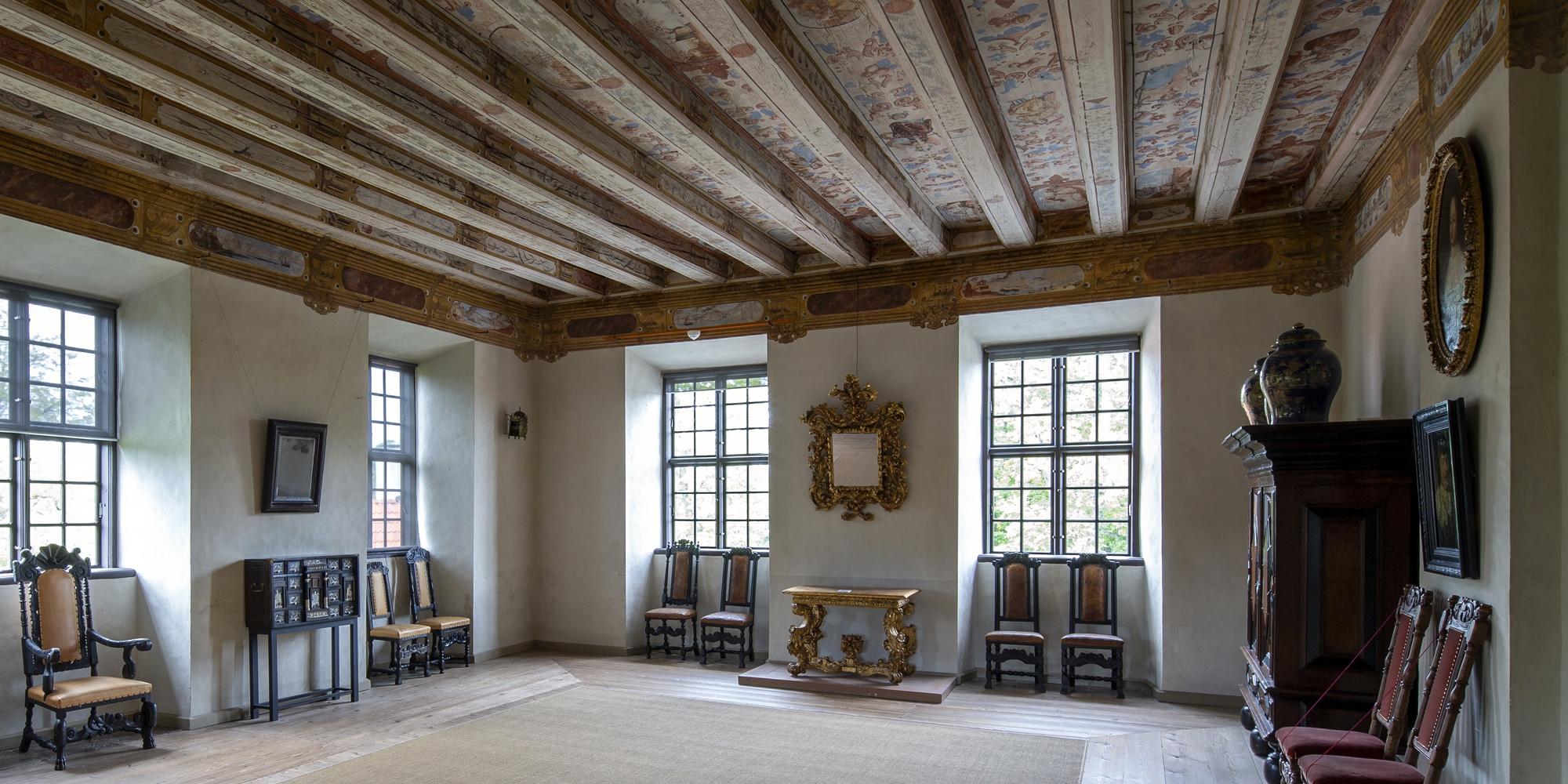
Take a closer look at the ceiling paintings at Louhisaari.
The ceiling painting in the Banquet Hall is a rare gem. It differs from the other ceiling paintings at Louhisaari and from contemporary Swedish ceiling paintings due to its diverse range of subjects. The landscapes, allegorical figures, and late Renaissance-style ornamentation depicted on the ceiling are based on Dutch and German engravings from the early 17th century. Some of the subjects in the panels of the frieze running around the ceiling depict the living environment of Louhisaari’s builder, Herman Fleming, and places associated with his life. The painting on the left side of the door leading into the hall was painted based on a copper engraving and depicts the Second Battle of Femern in the summer of 1644, in which Herman Fleming’s father, Claes Fleming, was killed.
The ceiling paintings in the banquet hall have survived better than other ceiling paintings on Louhisaari because they have never been repaired or painted over. The room’s plank floor dates from 1796. The room served as a dining room in the 1830s and as a library in the 1880s. Due to its grand proportions and ornate decoration, the banquet hall has also been called the “church hall.”
The ceiling paintings were signed by Jochim Langh (d. 1705), a native of Lübeck, who came to Sweden in the 1650s and worked, among other things, for the Admiralty in Stockholm. It was likely through this connection that Langh came to the attention of Herman Fleming, who held a leading position in the Admiralty. When Langh ran into trouble in 1660 after accepting work outside the painters’ guild, he is said to have “disappeared to the east,” which likely refers specifically to his arrival in Finland. In addition to Louhisaari, Langh worked as a decorative painter at Sund Church in Åland.
The furnishings of the banquet hall primarily reflect the style of the late 17th century, with Hamburg-style Baroque cabinets and high-backed Baroque chairs. Some of the chairs come from Louhisaari; the magnificent armchair was once part of the Jarppila estate in Taivassalo. The gilded wooden Baroque table was made at the turn of the 17th and 18th centuries in Burchardt Precht’s workshop in Stockholm; the South German gilded mirror above the table is from the same period. Cabinet cabinets, whose design traces its roots to Spanish and Portuguese travel writing cabinets, were among the most luxurious pieces of reception room furniture in the early and mid-17th century. The portraits of the monarchs displayed in the hall depict Charles XI’s wife Ulrika Eleonora the Elder, Charles XI and Ulrika Eleonora, their children Charles (Charles XII) and Hedvig Sofia, Frederick I, and Ulrika Eleonora the Younger.