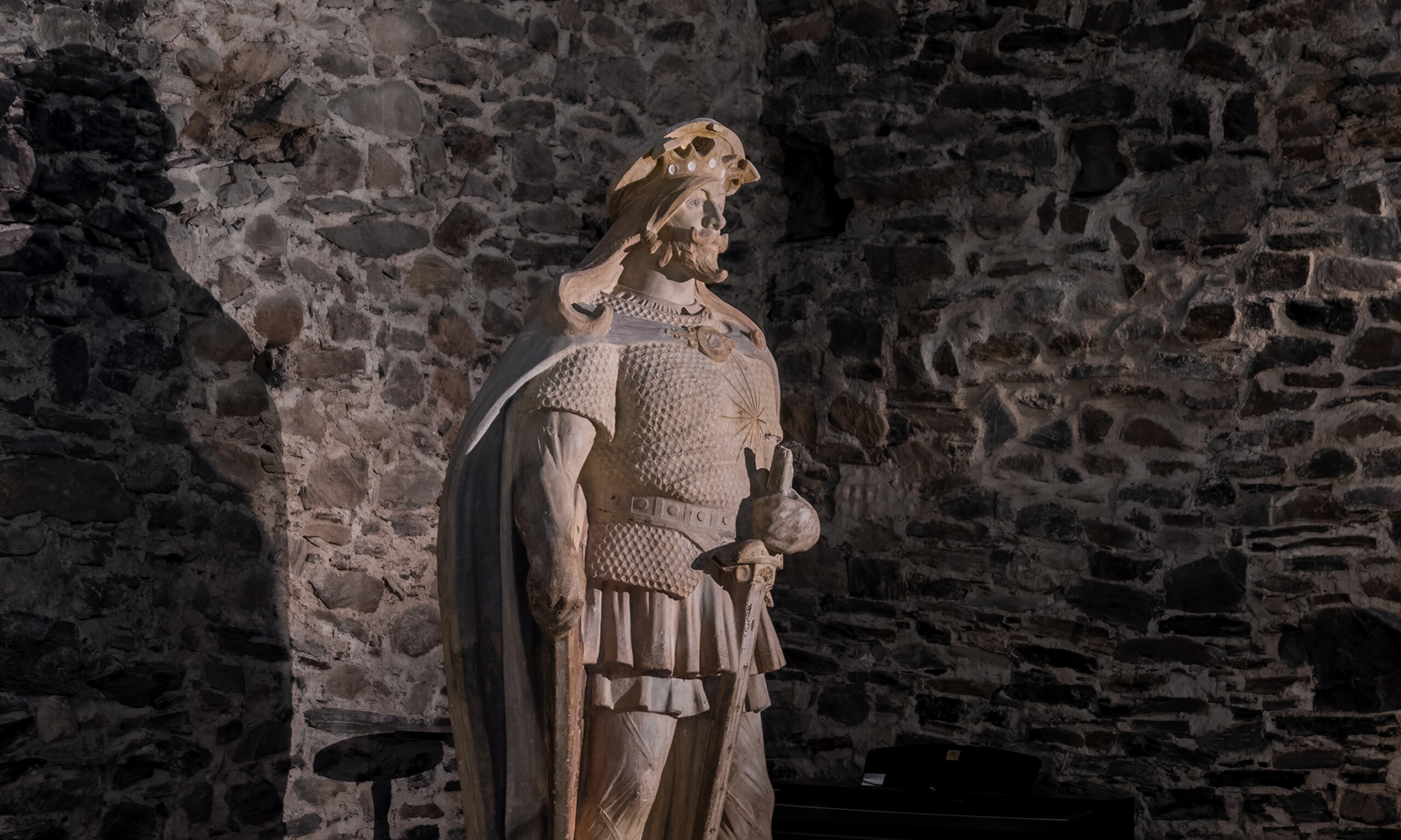
At first, Saint Olav became the patron saint of all of Norway, but the cult of Olav spread fairly quickly to other parts of the Nordic region and reached the territory of present-day Finland. At least judging by the number of church buildings dedicated to him, Saint Olav was, alongside the Virgin Mary, Finland’s most popular saint in the mid-13th century. Saint Olav became the most popular saint among the common people in the Nordic countries; here he was regarded as a mighty and protective king who, with his sword in hand, provided safety and shelter.
Today, Saint Olav is naturally remembered for Olavinlinna Castle, but also for other monuments erected in his honor. The Saint Olav Main Route runs from Turku through Ulvila to Savonlinna and is part of the broader Saint Olav Pilgrimage Route.
The Statue of Saint Olav
Architect Johan Jacob Ahrenberg oversaw the restoration of Olavinlinna Castle in the 1910s. He commissioned sculptor Ville Vallgren to create a large statue depicting St. Olav, the castle’s patron saint. Vallgren, who was working in Paris at the time, agreed to carve a statue approximately three meters tall from sandstone “for the unreasonably low price of 3,500 marks.” The cost of the statue accounted for a significant portion of the entire restoration budget, but the Archaeological Commission approved the purchase, although it noted that the funds should preferably be used for the castle’s renovation.
Ahrenberg and Vallgren had collaborated before, as Ahrenberg had been the driving force behind a statue project that resulted in the acquisition of a statue depicting Torkkeli Knuutinpoika for Viipuri. The sculptures of Torkkeli Knuutinpoika and Saint Olaf are mirror images of each other in their composition. Ville Vallgren’s (1855–1940) best-known work is likely the Havis Amanda statue in Helsinki.
Ahrenberg’s original plan was to place the statue in the large doorway of the Thick Bastion (Paksu Bastion), but it was ultimately installed in the King’s Hall. Saint Olav was placed on a one-meter-high pedestal, and the statue originally featured colors as well as colorful decorative stones on its crown and sword. In the 1920s, the statue was moved to the main gate, where it welcomed visitors to the castle for many decades. During the move, the pedestal was lost, and the elements, combined with vandalism, took their toll on the statue’s original appearance. Following its most recent restoration in the 1970s, St. Olav was returned to the interior in restored form and has stood guard over the Central Hall ever since.
Olavinlinna Castle Chapel
Olavinlinna Chapel is located in the Church Tower, which in the Middle Ages was known as Saint Olav’s Tower, named after the castle’s patron saint, Saint Olav. Plans to build a chapel were likely already in place when the castle was founded in 1475, as there was no church within a reasonable distance in the area, and furthermore, the Catholic Church, under the leadership of Bishop Konrad Bitz, strongly supported the construction of Olavinlinna.
The chapel remained in ecclesiastical use until the 1630s, when it became too small for the needs of the time, and the King’s Hall was taken over for ecclesiastical use. After that, the chapel was used as a storage space and was apparently not well maintained, which resulted, for example, in the destruction of most of the medieval ceiling paintings. Among the remaining fragments of the ceiling paintings, one can make out leaf and flower motifs as well as coats of arms; in addition, twelve wedding crosses run along the walls. The chapel has three altars: a reconstructed main altar and two side altars, as well as a sacristy niche. The main altar features a wooden crucifix carved by Hannes Autere.
The chapel includes a feature unique in Finland: a hagioscope. Behind an opening in the chapel wall is a chamber where people considered impure or sinful—such as criminals or the sick—could be placed. Through a small opening in the hagioscope, they were able to follow the service.
Today, the chapel is ecumenical, and private events, such as weddings and baptisms, can be held there. Visitors can explore the chapel on guided tours of Olavinlinna Castle, which are held year-round during the castle’s opening hours.
Saint Olav’s Day
The city of Savonlinna celebrates its birthday every summer on Saint Olav’s Day, July 29. On that day in 1030, the Viking king Olav Haraldsson fell in battle; thanks to his miracles, he became a favorite saint of both Catholics and Orthodox Christians. Saint Olav’s Day was part of the church calendar from the 1200s to the 1500s, and in some places even into the 1700s. To this day, July 29 is the name day for Olavi and Olli in the Finnish name day calendar.
In the 13th century, Saint Olav’s Day was celebrated with Masses and prayer services in churches dedicated to Saint Olav or at Saint Olav altars. Olav’s Day became the day on which summer town meetings were held. In larger parishes, which attracted large crowds, people gathered to hold council meetings and organize markets. Olav’s Day thus became a common market day. The day also incorporated elements of harvest festivals, and the celebration included the sacrifice and consumption of a sheep. Even at Olavinlinna Castle, a black ram was raised for Saint Olav’s Day right up until the period of Russian rule. In Savonlinna, the tradition of the “Saint Olav’s sheep” is commemorated today by, among other things, the ram statue on Tallisaari Island.