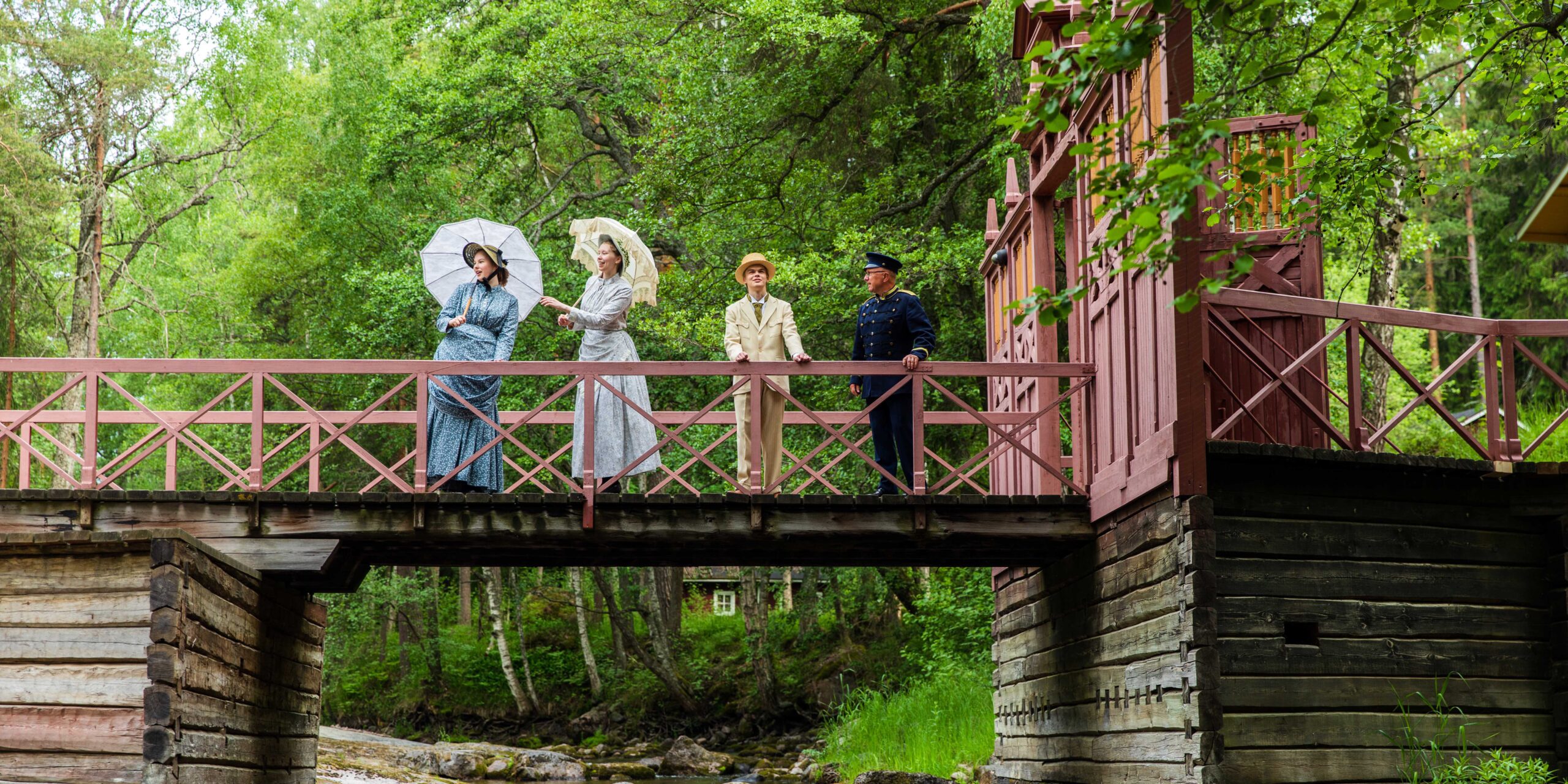
The Imperial Fishing Lodge at Langinkoski was built in the late 1880s as a summer retreat for Russian Emperor Alexander III. Although modest for an imperial residence, the lodge’s style exudes a simple elegance. The museum area features several buildings from the imperial era, surrounded by a nature reserve. The lodge has served as a museum since the 1930s.
Langinkoski is a fascinating destination that combines a refreshing nature excursion with traces of the shared history of Finland and Russia. It is a unique destination on a Finnish scale.
A Significant fishing spot
Langinkoski has been an important fishing rapids for centuries. The most sought-after catch was salmon. The oldest building in the museum area, a small Orthodox chapel known as a tsasouna, is a reminder of the area’s fishing history. It was built by monks from the Valamo Monastery, to whom Russian Emperor Paul I had granted fishing rights to the area in the 1790s. The tsasouna was used to consecrate the fishing waters at the start of the fishing season.
The holder of the rapids’ fishing rights has varied over the centuries through various lease and donation agreements. Finns, Swedes, and Russians alike have fished at Langinkoski, and it is said to have been one of Finland’s best salmon rapids. Since then, the original salmon population of the Kymijoki River has become extinct. Key factors included pollution problems that escalated in the 20th century and the damming of the river. Today, fish are once again thriving in the rapids. Metsähallitus sells fishing permits for the Langinkoski area.(ulkoinen linkki)
The Imperial Fishing Lodge at Langinkoski is being built
In the summer of 1880, Crown Prince Alexander Alexandrovich visited the Langinkoski salmon fishery. The scenic rapids and bountiful catches made a strong impression on the future emperor. In 1887, Alexander III, now crowned emperor, returned to Langinkoski to observe the salmon fishing. He was accompanied by Empress Maria Feodorovna, née Princess Dagmar of Denmark. As a result of the visit, the autonomous Grand Duchy of Finland received an order: an imperial fishing lodge was to be built at Langinkoski, and the fishing rights for the rapids were to be transferred from the Grand Duchy to the Emperor.
The fishing lodge was designed by Finnish architects. The architects of the General Board of Public Buildings, Director General Sebastian Gripenberg and Magnus Schjerfbeck, drew up the construction plans, and Jac Ahrenberg designed the interior. The imperial couple visited with their children to observe the progress of the construction work. The grand housewarming celebration for the fishing lodge was held on July 15, 1889. Among the distinguished guests were the Queen of Greece and the Duchess of Edinburgh. Delegations arrived by ship from as far away as Helsinki and Vyborg to greet the royal couple.
With its imposing fireplace and original furnishings, the fishing lodge is a complete work of art, much like the artists’ villa at Hvitträsk. It is one of the earliest examples of the National Romantic style in our country. The construction method is based on traditional Finnish timber framing, carried out at the Emperor’s express request in a “simple and rustic” spirit. The interior represents the best of Finland’s nascent industrial sector. Some of the lodge’s original furnishings have been preserved and are still on display at the museum.
The fishing lodge as the imperial family’s summer retreat
The imperial family arrived in Langinkoski in the summer as part of their Gulf of Finland cruises, sailing on the Tsarevna, which was specifically the Empress’s yacht. At the cottage, the imperial couple spent time with family, relatives, and friends, returning at night to the comforts of the elegant yacht. Finland was an ideal vacation destination for Alexander III, who was concerned about his family’s safety. The Finns were considered loyal subjects, and the lodge, surrounded by water, was easy to guard.
At Langinkoski, court etiquette—which otherwise so strictly dictated the imperial family’s daily routine—was also left far behind. At Langinkoski, the imperial guests fished, chopped wood, went on excursions, and prepared their own meals. This down-to-earth summer lifestyle drew astonishment in St. Petersburg society, but that did not prevent the imperial family from returning to Langinkoski. For five years, Langinkoski served as the imperial family’s summer hideaway.
Nicholas II ascends to the throne
The sudden death of Alexander III in 1894 marked the end of an era at Langinkoski. The imperial throne passed to Nicholas II, who also became the new master of Langinkoski. However, he visited the estate only once after his accession. On that occasion in 1906, Empress Alexandra Feodorovna was accompanied at Langinkoski by the imperial family’s four daughters: Olga, Tatiana, Maria, and five-year-old Anastasia.
Continuing his parents’ cruising tradition, Nicholas II did spend his summers in Finland with his family, but instead of Langinkoski, their trips often headed to Virolahti. Also accompanying Nicholas II on his cruises was the Dowager Empress Maria Feodorovna, who never returned to Langinkoski after her husband’s death.
World War I brought changes to Langinkoski. For two summers, the fishing lodge served as a Red Cross convalescent home for Russian soldiers. Fortification work was also carried out on the riverbank as part of the Kymijoki-Päijänne defense line. They were never used in battle, as the war ended before the fortifications were completed.
The era of independence and museum activities
With Finland’s independence, the lodge passed to the young Finnish state. The area and its buildings remain state-owned. The future of the Imperial Fishing Lodge was uncertain in the 1920s, and there were even proposals to demolish it. However, the lodge was preserved and occasionally served as a summer retreat for statesmen. The fishing rights for the rapids were leased out.
The fishing lodge was converted into a museum in the 1930s, when a group of local leaders founded a museum society with the aim of preserving the lodge’s imperial history. The Kymenlaakso Museum Society, now known as the Langinkoski Society, managed the museum’s operations until the end of 2017. Currently, the National Museum of Finland is responsible for museum operations at Langinkoski.